Maybe just the two of you, a nice dinner, maybe a little candle light…I am afraid I am talking about a different kind of dating.
A friend pointed me to this YouTube video by Mark Driscoll of Mars Hill. (I will give Driscoll credit, I see that his blog has a series on Charles Spurgeon, who I agree was one of the greatest preachers ever to live.) There are lots of things that we may quibble point out are wrong in this video on the Trinity, but shall we just start with the title topic, “Targum Neofiti?”
httpv://www.youtube.com/watch?v=U6mVLmSMRMU
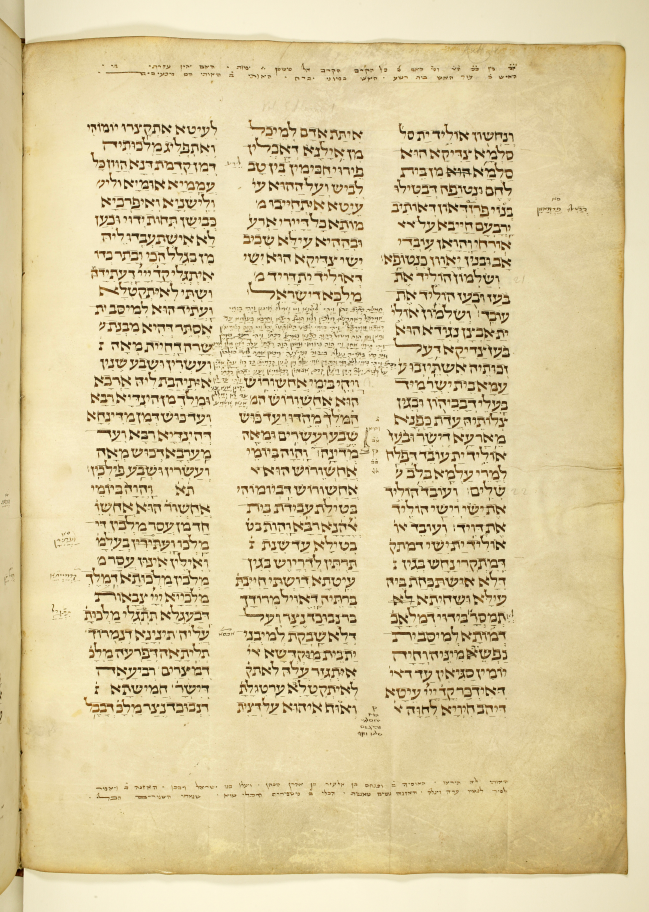
The first is the date. TgNeof is most likely late second century CE not BC(E) as Driscoll states. Furthermore, his entire argument rests on an erroneous translation. He says that TgNeof Gen. 1. reads “In the beginning with the Firstborn God created….” It should be “From the beginning, with wisdom, the Lord created…” The text reads מלקדמין בחכמה ברא {ד}ייי I do not have a critical edition to hand and the text I just copied comes from the Accordance module, but I see no variants noted (other than the dalet in ד}ייי} ).
So the term “with wisdom” seems certain and it is certainly nothing like “firstborn,” .בכורא What Neof is doing is referring to Prov. 3.19 “The LORD by wisdom founded the earth; by understanding he established the heavens.”
Feel free to offer other comments on the video. For the first time I have actually left comments on a YouTube video because I think this is so egregious. And for those who don’t know me as well and to be open and clear, I do believe in the Trinity, I just abhor bad sermons and errors.






25 thoughts on “How would you like to date Targum Neofiti?”
Apart from your valid observations… what do you suppose the chances are that Mark has ever heard of the divine council?
I came across an interesting article several months ago by Michael B Shepherd entitled, “Targums, the New Testament, and Biblical Theology of the Messiah.” (JETS 51:1). In it he makes several points that at least pertain to the issue at hand. Furthermore I’d be interested in your critique of his article.
Regarding the dating of TgNeof Shepherd refers to Paul Kahle’s analysis when he says,
“Due to its pre-Mishnaic features, Kahle held that the
Palestinian Targums as represented by Targum Neofiti was in
circulation by the second century BC in essentially the same
form as the manuscript discovered by Macho” (46-47).
Secondly (and more to the issue at hand) Shepherd quotes Gen 1:1 in TgNeof yet he translates the text as follows, “In the beginning, with wisdom, the Son of YHWH created the heavens and the earth” (51). His support for this view is founded on 1) that Prov. 30:4 “reveals that the one who established all the ends of the earth has a Son [sic]” (51). Secondly, that ברא, ought to be understood as “the son” rather than “he created.” In his opinion this is possible for, in Aramaic, ברא may be rendered as בר “son” with א standing in as the definite article. He furthers his support by providing the word following דייי, which is שכלל. This, he translates as “he created.”
So, is Shepherd’s analysis misguided, spot on or somewhere in the mix?
——————–
Shepherd, Michael B. “Targums, the New Testament, and Biblical Theology of the Messiah.” JETS. 51:1 (2008), 45-58.
Shepherd is rather out of date on his scholarship, by several decades. The earliest date that most scholars who work on the Targums would give today for Targum Neofiti and the Palestinian Targums in general is third century CE, or perhaps late second century. For the problems with Kahle’s and Diez Macho’s early dating, see the important article by: York, Anthony D., “The Dating of Targumic Literature.” JSJ 10 (1979): 49-62.
Matt
The problem with Shepherd’s translation is that it ignores the Hebrew text which uses ברא as “created,” which is obviously the source of the LXX as well. And adding “Son” is also quite a leap.
Thanks for the reply Jimmy. Seeing that I am still in the learning stages of Classical Hebrew, I am always looking for others more learned than I to help guide me.
What’s really interesting is that this targum’s correct translation of “wisdom” lends itself even more to the Socinian view of God and Anthony Buzzard’s explanation of this view especially in the book of John. All Trinitarians should at least consider reading Buzzard’s books on the Trinity. I was brought up Trinitarian, but I’m almost convinced that’s it’s not correct.
In the editio princeps of Neofiti 1, Martin McNamara translated Gen 1:1 as follows: “From the beginning with wisdom the Son of the Lord perfected the heavens and the earth.” In a footnote he says, “The word Memera, logos, is probably missing in the text, as a hand has erased the waw of shaklel, and therefore one should translate: `From the beginning (the Word) of the Lord with wisdom created and perfected the heavens and the earth,’” and this is how he translated it (with different word order however) in his translation for The Aramaic Bible. I have a different suggestion based on two similar texts in Neofiti.
In transliteration Neof Gen 1:1 is as follows (S represents unpointed shin):
mlqdmyn bxkmh br’ dyyy Skll yt Smy’ wyt ‘r`a
Frg. Tg. P has it:
bxkmh br’ yyy wSklyl yt Smyh wyt ‘r`’ (with marginal gloss mn lqdmyn)
With the gloss this is much like Neofiti except that Neof has dyyy which justifies treating the preceeding word as a noun (“the son”).
Neof. Exod 31:17 reads as follows:
Sth ywmyn br’ yyy yt Smy’ wyt ‘r`’ etc. with a gloss wSkll mymryh dyyy, giving a full text, “In six days the Lord created and the Word of the Lord perfected the heavens and the earth.” You have basically the same text and gloss in Neof. Exod 20:11
Now suppose the text being copied in Gen 1:1 read as the above with the gloss included:
mlqdmyn bxkmh br’ yyy wSkll mymryh dyyy yt Smy’ wyt ‘r`a
Again, the extant text reads as follows:
mlqdmyn bxkmh br’ dyyy Skll yt Smy’ wyt ‘r`a (with evidence of erasure of the waw before Skll)
To get our extant text from Exod 20:11/31:17 (with gloss) would necessitate more than an accidental copying mistake (which would be especially dubious in the very first verse being copied!)
Diez-Macho (editio princeps) suggested that the erasure of the waw is for the purpose of giving a Christian sense to the verse. Remember that the name “Neofiti” comes from the name of the college established by the Vatican for Jewish converts to Roman Catholicism (i.e., neophytes). Suppose such a 16th century neophyte, while copying from ancient manuscripts, decided that in the very first verse he wanted to give a clue or example to how he thought the Memra should be related to the Logos of John’s Gospel, and so he altered the text by omitting the 4th and 6th words (yyy and mmryh) and switching the 5th and 7th (wSkll and dyyy); then he noticed that he needed to do one more thing to make the verse read “properly” according to this interpretation: he had to erase the waw. the result is that he replaced “Word” with “Son” (by forcing br’ to be a noun).
So to this extent Driscoll is not as far off as he might seem (still mixed up however).
Hopefully by this Fall’s ETS/SBL, Hendrickson will publish my book looking at all of John’s Gospel in light of the Targums. I think the evidence is overwhelming for the Targum origin of the Logos title. In response to Jeff I would comment that this does not at all lead to support for Socinianism, since John has adapted the Memra (and Dibbura), not taken the concept over unchanged from the Targums. John’s point is to show Jesus as the God of Israel, (the Word was God), but also to show him in subordination to the Father (the Word was with God).
Thank you John! I will correct, with your permission, your first comment, and then create a new post to point folks to your suggestions. Do you want to give more bibliographic information of your forthcoming book?
Chris – sure, go ahead (I see I also used “a” in transliterating aleph a few times instead if ‘). Hendrickson has the last word on the title, which has yet to be determined, but I would like it to be “When YHWH Became Flesh: The Targum Origin of the Logos Title.” I believe John 1:14 is programmatic for the Gospel as a whole, John shows doing in the flesh the same kinds of things he did in OT times in saving his people by divine warfare, revealing his name, coming down from heaven, giving the law, being their bridegroom. My article “The targum of Isaiah and the Johannine Literature” (WTJ, Fall 2007) is a bit of a preview. If you are interested is available at http://f1.grp.yahoofs.com/v1/8Kc7Spt9Wts62y0WRmIIcJjv4-CmGy8f0QGwK8iwINratquo-iXeqhaDDfn4qHBCJlIDR1Yo_0XwDyrdKuunBtykbCuFwA/Ronning_WTJ-Fall07-topress.pdf
Sorry I have problems counting: 3rd to last paragraph should read . . . “omitting the 4th and 6th words (yyy and mmryh) and switching the 5th and 7th (wSkll and dyyy) . . .
Corrected in the body of your first comment.
It’s an interesting hypothesis. But isn’t it easier to simply go with the dropped waw (and, if you like for the hypothesis of intentional Christianizing of the text, the addition of the daleth before yyy)?
If the waw is added it can simply be read as “In the beginning in/with wisdom created yyy [and] he finished the heavens and the earth.”
A bit of a shift in subject but some of you may be interested in my book which Hendrickson has just published: The Jewish Targums and John’s Logos Theology
John (Ronning),
I just ordered your new book on the Targums and John’s Gospel, and based on the endorsements, I’m very much looking forward to receiving it.
As the index indicates (accessed at Amazon), however, you appear not to be aware of my use of these traditions in Jewish apologetics. The relevant volume in the five-volume series Answering Jewish Objections to Jesus is Vol. 2, Theological Objections (Baker), specifically sections 3.1-2. Perhaps you’ll find confirmation for some of your thinking there as well, and again, I look forward to getting your monograph.
“The first is the date. TgNeof is most likely late second century CE not BC(E) as Driscoll states.”
This statement is in error just as much as Driscoll’s. Their simply is not enough evidence for one to hold a determinative position either way.
Not true Rob. There is enough linguistic evidence to show that TgNeof is mid-2nd Century CE at the earliest and possible later. Note, there is a 400 year swing between Driscoll’s date and the (general) date upon which Targumic and Aramaic scholars have reached consensus. There is, however no evidence to support a BCE dating.
No doubt the evidence is not as clear cut as a tidy colophon saying “This was translated in ______” thus the “most likely” caveat, etc. But to say that Driscoll’s dating (which, to give him credit, was most likely his unwittingly repeating someone else’s error) is as well supported is incorrect.
Mr. Brady,
I appreciate your study on the matter; however, I have one problem with your blogging. As a researcher, shouldn’t you provide documentation to give your argument some credibility? I know that your credibility comes through your various degrees and extensive research, but I believe your claim is not credible until I see some documentation in your blogging.
Though Driscoll’s claim may be wrong and unsubstantiated according to your research, please provide documentation supporting your claim in order to give credibility to your argument. As you know, people believe what is on the internet more often now, which means they believe it without the proper citation. So, please give credibility to your argument by providing sustenance supporting your claims versus arguing a point without giving credit where credit is due.
Dear Mr. Brown,
I can’t help but wonder if you were trying to make a point by addressing me as “Mr” rather than “Dr,” although you do allude to my education and degrees in the body of your message. I am very happy for folks to address me as “Chris” or “Christian,” as they are comfortable (although most of my students address me as “Dean”). I am not overly concerned with titles.
Given that you are not, however, satisfied that I know my trade and training I suggest you begin your investigation with Philip S. Alexander, “Jewish Aramaic Translations of Hebrew Scriptures.” In Mikra: Text Translation,
Reading and Interpretation of the Hebrew Bible in Ancient Judaism and Early Christianity. Compendia Rerum Iudaicarum ad Novum Testamentum: Section 2, Vol. 1, 217-254. Edited by M. J. Mulder and H. Sysling. Philadelphia: Fortress Press, 1988. From there you can follow the footnotes and turn to any introduction to targumic or rabbinic literature (such as Jack Neusner’s Intro to Rabbinic Literature with a section on the targumim by Paul Flesher).
It is certainly admirable to question sources, but if doubt my credentials and expertise I am not sure why you would trust others such as Alexander, Neusner, Flesher, Shinan, etc.
you handled that one better than i would have 😉
The neofiti and Pseudo Jonathan appear to be expansions moreso than just Aramaic translations.
This is why,IMO,the terms “Son”,”logos”,”name of My Word” are often appearing where they didn’t in Massoretic or LXX texts.
It’s not that unusual,Nehemiah 8:1-8 appears to be a possible example of this activity by the priesthood and I assume it was penned several centuries before Christ.
The “firstborn” translation is justified by wisdom being “begotten” in Proverbs as well as the Memra theology in the Targums. It all relates, as the angel of YHWH is called “the word of YHWH” in texts like 1 Kings 18:31 and the wisdom of YHWH proceeds from YHWH’s mouth, and so is also the word of YHWH. The Memra/Wisdom is the Angel and the Angel is begotten.