Targuman Rotating Header Image

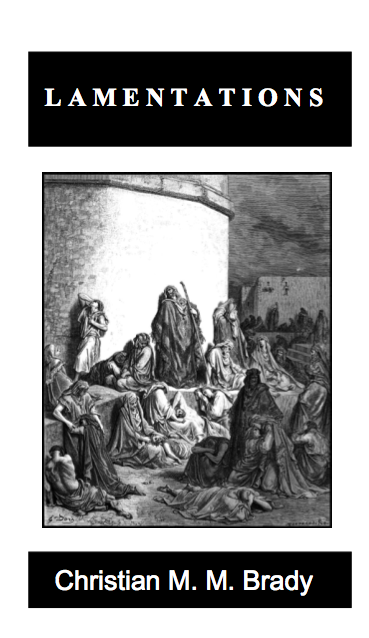
Lamentations

Targum Studies: The Exegetical Method

Solger MS of TgLam

TgLam 3:18, Solger MS

As I am working on my new book on Targum Ruth I am also editing my doctoral thesis to get it into eBook form (well, truth be told, an undergrad is doing the editing). One matter that I laid out in the thesis and my book that I think is still valuable is the need for us as scholars to be explicit in our methods. Or at least to be as conscious of them as we can be. In the following I lay out my argument for what I call “the Exegetical Method” for analyzing Targumic Literature. I was working on Targum Lamentations at the time so the examples all come from that text. For citations (there were far too many footnotes to sort out and, as I have suggested before, I hate endnotes) please see the PDF of my thesis available here.

The Exegetical Method

Although targumic literature has been studied extensively over the last several decades, there has yet to be a systematic presentation of a critical methodology for the reading and interpretation of targumic texts. There are critical studies of the targumim, but they have tended to focus upon textual and recensional issues and relied upon relatively self-evident methods of analysis. Several scholars have focused upon the literary and theological aspects of the targumim, but they tend to articulate the method with which they will approach the particular text at hand rather than argue for a more general method that would be usable in the study of other targumim. On the other hand, there is the invaluable work of Klein, who examines many different targumim in order to reveal patterns in the translational method of the targumist.

It would appear that the field of targumic studies is lacking what biblical studies has taken for granted for the last 100 years: an armory of articulated critical methodologies from which we might choose that which best applies to a given text and approach. In this section I will present a general critical methodology that can be applied to targumic texts in order to determine their exegetical, or theological, perspective. This proposed method for discerning the exegetical perspective of a targum, which I will refer to as the “Exegetical Method,” involves three main steps.  (more…)


Word Clouds Illuminating Interpretation: Lamentations

Yesterday, as simply a means of illustrating the announcement about the new book on Lamentations I quickly created two word clouds of the Book of Lamentations and the Targum of Lamentations. As with Ruth there are some interesting observations one can make from this simple graphic. For those not familiar, Wordle.net  tags the words you input and produces a “cloud” of words.

The clouds give greater prominence to words that appear more frequently in the source text.

A few limitations for biblical studies is obvious: (1) I am using English translations. In this case NRSV and my own of TgLam. (Wordle will do Hebrew, however, so I should try that too. (2) This is just an approximation. The size of a word is based upon its frequency, but the images are evocative and point to real data.

All of this is reminiscent of my very first paper and article (“Targum Lamentations 1:1-4: A Theological Prologue,”) in which I did a very simple word count to see how many words the targumist had added to the opening four verses of Lamentations relative to the other verses in TgLam. The results were indicative that something was going on there. The article (and later, my book) get at just what that is.

So let’s look at the word clouds and make a few observations.

“The LORD” stands out in both (all) word clouds and with good reason. The term occurs throughout the text. While Lamentations descries the horrible atrocities of the siege and destruction of Jerusalem, the poet refuses to not engage God. The cry, lament, and accusation all are directed to the LORD. That does not change in the targum, in fact it gets even more insistent.

Now, notice that “daughter” (בת) is prominent in the biblical text. In the targum we find “congregation” (כנשתא). This is because the targumist has consistently (but not exclusively) translated the Hebrew בת with כנשתא. The effect, as I have written elsewhere is to remove the poetic “daughter Jerusalem” with the more prosaic yet profoundly person “congregation of Israel.”1 What was an oblique reference to the citizens of the once great city is now an address to those seated in the synagogue, in the congregation, hearing these texts read on Tisha b’Av. Instead of a tedious recitation about something that happened long ago and far away, it is now about you and me, about us and our relationship with God.

Of course these observations came after quite a lot of actual reading of the texts. But it is interesting to see, quite literally, it present in the texts before us. (Be sure to click through to see the English word clouds as well.)

Lamentations - Accordance Module

Targum Lamentations - Accordance Module

(more…)

 
  1. As with all biblical poetry, Lamentations is rendered as prose. This is something I termed “prosaic expansion,” but was first observed in publication by Moshe Bernstein with regards to TgPss. []

Proofs are here! New Book on Lamentations

A year ago, almost to the day, I shared with you all that a new book was forthcoming on the topic of Lamentations and its interpretation in Christianity and Judaism. Yesterday I received the proofs and Great Is Thy Faithfulness: Reading Lamentations as Sacred Scripture should be ready for purchase at SBL! The publisher is now Pickwick Publications/Wipf and Stock. The book is edited by Robin Parry and Heath Thomas. The table of contents follows below.

You know I like wordle.net so here is the Book of Lamentations and below is Targum Lamentations.

Great Is Thy Faithfulness: Reading Lamentations as Sacred Scripture

Introduction—Robin A. Parry and Heath A. Thomas / xi

1 “Holy Scripture” and Hermeneutics: Lamentations in Critical and Theological Reflection—Heath A. Thomas / 1

2 Outrageous Demonstrations of Grace: The Theology of Lamentations —Paul R. House / 26

Soundings in Jewish Reception History

A Lamentations in Isaiah 40–55—Lena-Sofia Tiemeyer / 55

B The Character and Significance of LXX Lamentations —Kevin J. Youngblood / 64

C Targum Lamentations—Christian M. M. Brady / 70

D Lamentations Rabbati—Jacob Neusner / 77

E Introduction to Rashi’s Commentary on Lamentations —Mayer I. Gruber / 83

F Lamentations in Jewish Liturgy—Elsie R. Stern / 88

G Lamentations in Modern Jewish Thought—Zachary Braiterman / 92

Soundings in Messianic Jewish Reception History

H Holocaust Theology in the Light of Yeshua? Messianic Jewish

Reception of Eikah—Richard Harvey / 101

Soundings in Christian Reception History

I Lamentations in the Patristic Period—Heath A. Thomas / 113

J Christian Interpretation of Lamentations in the Middle Ages —David S. Hogg / 120

K John Calvin’s Interpretation of Lamentations—Pete Wilcox / 125

L Lamentations for the Lord: Great and Holy Friday in the Greek Orthodox Church—Eugenia Scarvelis Constantinou / 131

M Lamentations and Christian Worship —Andrew Cameron-Mowat SJ / 139

Soundings in Artistic and Contemporary Reception

N Musical Responses to Lamentations—F. Jane Schopf / 147

O Lamentations in Rembrandt van Rijn: “Jeremiah Lamenting the Destruction of Jerusalem”—Heath A. Thomas / 154

P Psychological Approaches to Lamentations—Paul M. Joyce / 161 Q Feminist Interpretation(s) of Lamentations—Heath A. Thomas / 166

3 Wrestling with Lamentations in Christian Worship—Robin A. Parry / 175

4 Confession and Complaint: Christian Pastoral Reflections on Lamentations—Ian Stackhouse / 198

Appendix 1: A Translation of LXX Lamentations—Kevin J. Youngblood / 211

Appendix 2: A Translation of Targum Lamentations —Christian M. M. Brady / 228

Appendix 3: Lamentations Rabbati on Lamentations 3:1–21 —Jacob Neusner / 248

Appendix 4: Rashi on Lamentations 3:1–21 / 264

Appendix 5: Calvin on Lamentations 3:1–23 / 267


John Hobbins Reconstructing Lamentations

Megillat Eicha, Alsace c. 18th century (image: Learn.jtsa.edu)

John has an intriguing post regarding Lam. 3:51: Lamentations 3:51: A New Proposal This is a notoriously problematic passage and John has an interesting proposal for a textual reconstruction. Of greater interest to me is his broader conclusions that I am not sure that I can agree with.

On this reading, in 3:1, at the onset of a larger whole, a female lamenter explicitly casts herself as a male persona, an “everyman” (Hillers’ characterization (1992:122) developed by Dobbs-Allsopp [2002:105-109]) who gives voice to a collective experience, only to allude to her particular identity in 3:51. In the poem’s conclusion, 3:52-66, the singular “I” continues to be used, but, as Dobbs-Allsopp notes (107), “it has become more inclusive.” As she did throughout Lam 3, the lamenter concludes by voicing the grief and hopes of an entire community.

The public articulation of grief by women is extremely well-attested cross-culturally. The details have become the subject of intense study by anthropologists. Those familiar with this research will formulate, almost as a matter of course, a working hypothesis: Lam 1 is a dialogue in which (a) a chorus of lamenting women provide a context for the voice of (b) a single lamenting woman speaking in the voice of Zion: (a): Lam 1:1-11 except for 1:9c and 1:11c; (b): Lam 1:9c.11c.12-22. Lam 2 is easily understood as a dialogue between two lamenting women, (a) a lamenter who speaks of and to Zion, and (b) a lamenter once again speaking in the voice of Zion: (a) 2:1-19; (b) 2:20-22. On this understanding, it is one of “the maidens of Jerusalem” spoken of as a lamenter in Lam 2:10 whose words we hear in 2:11-12 with its focus on children and mothers. Lam 3, with 3:51 construed as suggested above, is a monologue of a lamenting woman, a female citizen of her city, who gives voice to the grief and hopes of an entire community.

It seems to me that John makes a tremendous leap from his textual analysis to proposing a female author (even one that poses as a male persona). John is of course correct that women are often those most visible and vocal in the grieving process in many cultures and indeed it has been the subject of a great amount of study lately. At the risk of being labelled a misogynist, I would suggest caution when moving from that research to the reconstructions offered by John. I am sure that those familiar with such research would offer such a hypothesis but it seems overly cumbersome.

The most obvious hurdle is that the text itself takes the voice of a man. Would we not have to then argue that the original female author (which seems to be John’s argument) felt the need to present her laments as a male composition because, presumably, the culture would not accept a composition written by a woman. Yet if the culture is so affirming of women as lead lamenters then why would they not also accept such a composition? Certainly the identification of  Zion as woman and Daughter Zion introduce the feminine perspective (and see Dobbs-Allsopp and Linafelt for more on these themes), but does that necessitate a female author?

Finally, does the gender of the speaker or author matter? That is to say, do we read the text differently if we have a man or a woman in our consciousness as the author? It might provide us with slightly different nuances to our readings, but what do we gain exegetically? And that holds true even if arguing for a male author.

I can genuinely say that I do not feel a vested interest in whether it was a man or a woman (or, more likely, men or women) who wrote these laments. I just question whether or not such a thing is knowable and how it would change our readings. Then I wonder, should it? When we read an anonymous work we tend to take the words at their “face value” (a dubious concept, but you know what I mean), but once we know the author there can be a tendency to read that work through the filter of what we believe we know about the author and what we think their agenda might be.

Is it possible not to offer a gender neutral rendering of the text, but rather a gender neutral reading? Should that be our goal?

I also thought I would share with you all the targumist’s rendering and reading of the passage (Lam. 3:49-51). (You can find my translation of TgLam, my doctoral thesis, and other articles on this blog as well. See the tab above or go here.)

עיני זלגת דמעין ולא תשתיק מלמבכי מדלית פאיג עקתי וממלל תנחומין לי

עד כדו דסיתכי ויחזו עולבני יי מן שמיא

בכותא דעייני אסתקפת למרע נפשי על חורבן פילכי עמי וניוול בנתא דירושלם קרתי

49 My eye weeps tears and does not cease from crying. There is no respite from my anguish or anyone to comfort me;

50 Until the Lord looks out and sees my humiliation from heaven.

51 The weeping of my eyes is the cause of the affliction of my soul over the destruction of the districts of my people and the humiliation of the daughters of Jerusalem, my city.


“Have you forgotten us completely?” Crying Out to a Loving God

Below is the podcast of the talk I presented for Tisha b’Av at Beth Israel.