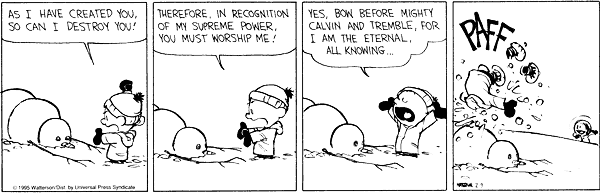
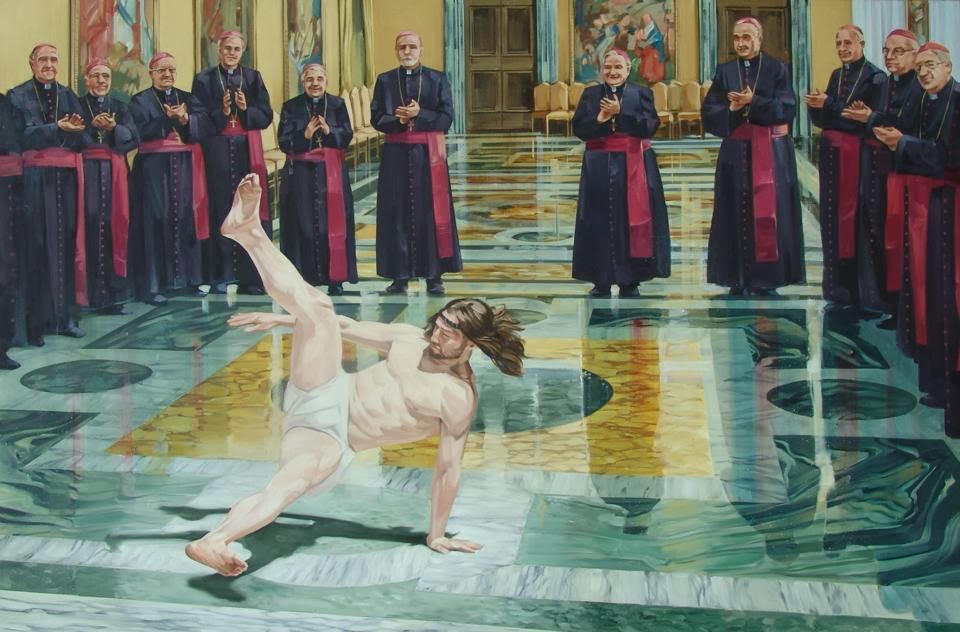
From Saturday Morning Breakfast Cereal.
Religion
Supreme Court Recognizes ‘Ministerial Exception’
In a decision with major implications for church-affiliated colleges and their employees, the U.S. Supreme Court unanimously held today that the First Amendment precludes the application of federal employment-discrimination laws to religious institutions’ personnel decisions involving workers with religious duties.
Many federal appeals courts and state courts had previously declared that there exists a “ministerial exception” to employment-discrimination laws rooted in the First Amendment’s clauses protecting religious freedom. Today’s ruling, however, is the first in which the Supreme Court formally recognized the “ministerial exception” as legal doctrine.
What is so good about “The Good Book”?
I am sure that I am late to this discussion, but this morning I was catching up on some podcasts. A great one that I think you will really like is PRI’s The World in Words. As the title implies, it is about words, language, and rhetoric around the world. The podcast I was listening to this morning was from December 12, 2011 and is about the Bible, the brain, and religion. There were several interesting assertions such as Britain’s Chief Rabbi Jonathan Sachs asserting that Hebrew, and other right-left languages, are right-brained whereas left-right languages are left brained, thus Christianity is more of an “evidenced based” religion. Is this a commonly held belief? I had not come across it before, I have to confess.
The other interview was with British philosopher A. C. Grayling and former Canon Chancellor of St Paul’s Cathedral in London Giles Fraser. They were discussing Grayling’s The Good Book: A Humanist Bible, which is just what its title suggests. What I wanted your opinion on is why anyone should consider this a “version” of the Bible? (As it was presented by the BBC’s John Humphrys who moderated the discussion.) Listen to the discussion which opens with a comparison of Gen. 2:15-17 with the opening lines of Grayling’s work.
15 And the LORD God took the man, and put him into the garden of Eden to dress it and to keep it. 16 And the LORD God commanded the man, saying, Of every tree of the garden thou mayest freely eat: 17 But of the tree of the knowledge of good and evil, thou shalt not eat of it: for in the day that thou eatest thereof thou shalt surely die.
Chapter 1
1. In the garden stands a greed. In the springtime it bears flowers; in the autumn, fruit.
2. Its fruit is knowledge, teaching the good gardener how to understand the world.
3. From it he1 learns how the tree grows from seed to sapling, from sapling to maturity, at last ready to offer more life;
4. And from maturity to age and sleep, whence it returns to the element of things.
5. The elements in turn feed new births, such is nature’s method, and its parallel with the course of humankind.
Of course this is not a translation or even a version of Genesis. It contains “truths” that I would suggest one could glean from the Bible and through natural revelation. This book that Grayling “modestly” offers (as the Canon pointed out, how modest can you be with your name on the spine of a book calling itself a “Bible”?) is intended to be a moral guide and text. Fraser rightly points out that the Bible is much more thank being about morality, it is about salvation. When Humphry said, but isn’t being saved all about doing good he was quickly corrected by Fraser. In fact, Fraser made my favorite point about the Bible, it is about real life and people, it is violent and messy with lots of things going on. That, to me, makes it far more compelling than a moral treatise (although the latter is no doubt better for battling insomnia).
Clearly Grayling is simply generating sales with the title of his book and perhaps it is the BBC’s fault for presenting this as a face-off between the KJV and the “Humanist Bible.” Still, it irks me that this should be presented as a “version” of the Bible. Its not.

On the other hand, I can firmly recommend the version of the Bible that my daughter gave me for Christmas: The Brick Bible: A New Spin on the Old Testament. This is the print version of BP Smith’s http://www.thebricktestament.com/. This is as valid a version as the many graphic novels out there (or R. Crumb’s Genesis). I recommend it, but it is not the complete Old Testament. Ruth is missing, for example. And Smith has made certain interpretations with which I disagree. For example, he seems to depict Jonathan and David’s love for another as something more erotic than platonic.
True, 1 Sam. 20:41 does say that they kissed and we know that they had a love for one another that went beyond that of a man for a woman and it is very much the trend to interpret this as a sexual relationship, but I am not convinced of that. My point? Not so much that Smith’s representation is wrong but that we can have a discussion about his interpretation. We cannot do that with Grayling’s “version” which isn’t.
Score:
LEGO Builders 1 — Philosophers 0
- Not very progressive is he? [↩]
Good question» Offensive or Not?
![]()
And does it help that the first one is actually a billboard put up by a church, or that the ad agency responsible for the second one is run by a Jewish man?
via Comics I Don’t Understand » Offensive or Not?.
Praying in Public Banned in Paris
The new law, reported by the Telegraph, is apparently being introduced because thousands of Muslims are praying in the streets, blocking traffic. A devout Muslim is required to pray five times a day. In the US where there is the founding principal of religious freedom such laws restricting religious practice is generally denounced (although remember the outcry about a mosque in NYC “near” Ground Zero?) but France, whose history included being effectively ruled by the Catholic church, maintaining a secular stance has been vigorously pursued by the government.
What do you think about such laws? How would you handle the challenges posed by the changes brought with a massive influx of immigrants with their own traditions, religious and otherwise?
Praying in Paris streets outlawed
Praying in the streets of Paris is against the law starting Friday, after the interior minister warned that police will use force if Muslims, and those of any other faith, disobey the new rule to keep the French capital’s public spaces secular.
By Henry Samuel, Paris
5:56PM BST 15 Sep 2011
Claude Guéant said that ban could later be extended to the rest ofFrance, in particular to the Mediterranean cities of Nice and Marseilles, where “the problem persists”.
He promised the new legislation would be followed to the letter as it “hurts the sensitivities of many of our fellow citizens”.
“My vigilance will be unflinching for the law to be applied. Praying in the street is not dignified for religious practice and violates the principles of secularism, the minister told Le Figaro newspaper.
“All Muslim leaders are in agreement,” he insisted.