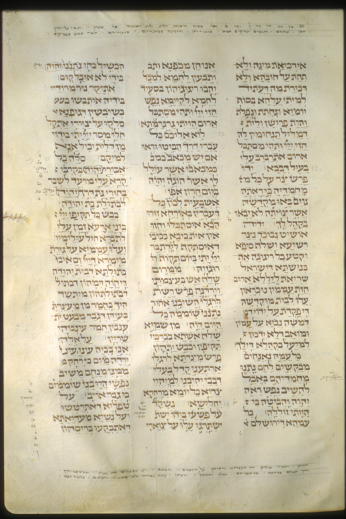
Targuman Rotating Header Image

Targum Lamentations

This page has now been updated with sub pages that can be navigated using the links in the right column of this page (see the “Pages” widget). On those pages you will find my translation of TgLam and images of the Solger MS.

Introduction:
My short introduction to Lamentations for the Bible Briefs series is available in a lovely pdf from Virginia Theological Seminary and Forward Publishing. Free download here.

Thesis:
I have decided to make my doctoral thesis “Targum Lamentations’ Reading of the Book of Lamentations” available on the net as a pdf since, to the best of my knowledge, there is only one copy at the Bodleian (call number MS. D.Phil. c.15589) which is not the most convenient place for many. There are many things I would change (and did in my book) and there are probably a few errors that I never corrected and so on. I must recognize the assistance and direction given by my supervisors Dr. Philip Alexander and Dr. Alison Salvesen. Needless to say any errors, misstatements, and general silliness is my fault, not theirs.

So I hope the thesis is of some use. All I ask is that it be properly attributed.

Translation:
If you would just like to read my English translation of the text, please see the sub page on this blog here. You can download an “eSword” version of the text via this link.

Book:
My book on TgLam is available in many libraries, but you can also purchase it from Amazon: The Rabbinic Targum of Lamentations: Vindicating God (Studies in the Aramaic Interpretation of Scripture, 3)

Articles:
I am in the process of asking permission from publishers to make them all available at this site.

The Date, Provenance, and Sitz im Leben of Targum Lamentations,” in The Journal of the Aramaic Bible 1, (1999), 5-29.

The Role of the מדת דינא (midat dinah) in the Targumim,” in Studies in Scripture in Early Judaism and Christianity, The Interpretation of Scripture in Early Judaism and Christianity, vol. 7, ed. Craig A. Evans, (Sheffield: Sheffield Press, 2000), 364-74.

Vindicating God,” in The Journal of the Aramaic Bible 3.1/2 (2001), 27-40.

Targum Lamentations 1:1-4: A Theological Prologue,” in Targum and Scripture: Studies in Aramaic Translation and Interpretation in Memory of Ernest G. Clarke. In Studies in the Aramaic Interpretation of Scripture, vol. 2, (Leiden: Brill, 2002). (Also available via Google Books.)

The following entries in The Dictionary for Theological Interpretation of Scripture. Eds., Kevin J. Vanhoozer, Craig G. Bartholomew, Daniel J. Treier, and N. T. Wright, (Grand Rapids: Baker Academic Press, 2005):

  • “Lamentations,” pp. 426-28.
  • “Targum,” pp. 780-81.

“The Use of ‘Eschatological Lists’ within the Targumim of the Megilloth,” in Journal for the Study of Judaism 40 (2009), pp. 1-17.


16 Comments

  1. isaac says:

    What is the time of the composition of Targum Lamentations – or at least the supposed century? Is there an concensus about this date?

    Many thanks!

    isaac

  2. Chris Brady says:

    Isaac, there is no strong consensus, other than that it is late. For my full discussion of this please see chapter 5 of my doctoral thesis (which you can download at the link above). But the relevant paragraph is this:

    Finally, there is very little clear evidence within TgLam which might indicate its date of composition. The references in 4.21-2 to Constantinople, Edom, Rome, Italy, Persians, and the “Parkevi” only serve to complicate the matter. The reference to Elijah as High Priest (a title found primarily in TgPsJ, which was redacted no later than the seventh century CE)#818 suggests a date of redaction sometime within the seventh century CE and this is supported by the rabbinic evidence.#819 Although the Talmud does not seem to be aware of any consistent use of a targum to Lamentations during the ninth of Ab service, Soferim 42b
    prescribes the reading of the Book of Lamentations and its targum as part of the commemoration of the destruction of the Temple. It is impossible to determine if the version of TgLam which we now possess is the same as that described in Soferim. However, it is clear that the practice of reading the Book of Lamentations and its targum as part of the synagogal worship on the ninth of Ab became institutionalized by the time of the composition of Soferim, roughly the seventh century CE.

    #818
    See §3.1.1 and §3.4.21.
    #819
    One must be cautious in employing an “argument from silence,” but it may be significant, and further justification of dating the targum to the first half of the seventh century CE, that there is no reference
    to Arabs or Muslims.

    My views have not changed since I wrote this. I am, however, becoming more convinced that many of the other targumim to the megillot are also from this general period. There does seem to be some consensus about this, but what all scholars who have addressed this issue seem to agree is that we cannot really make any definitive pronouncement about the date of the final form of these texts.

    I should add that it is clear that, as with all targumim, TgLam contains exegetical material that is far older than the final form that we have received. But I am also fairly certain that the “final” (as final as we can determine) redactor had a strong hand in organizing the material so that TgLam (and I believe the other targumim of the megillot) have a fairly consistent and coherent message. So the attempt at dating the final form is, in many ways, a dating of its “composition.”

  3. [...] Targum Lamentations [...]

  4. Jerry says:

    Thank you for posting your dissertaion. It is a penetrating work. Is there a way to tell which exegetical material of TgLam is “much older”? And if not, how do we know there is older material in it? How does one separate between what came from the final redaction and that what preceeded it?

  5. Chris Brady says:

    Dear Jerry, thank you for your note! There are a few ways that we can try and determine some sort of Redaktionsgeschichte but there can be no certainty. A few simple tests can be applied. We may compare certain aggadic additions to their parallels in other rabbinic texts. If we have some basis for a terminus ad quem, perhaps references to Persians or certain rabbinic practices, and we have a rabbinic tradition in which the aggadic or midrashic addition occurs that is earlier, then we can assume that the tradition, if not the targum, goes back to at least the date of the earliest midrashic/rabbinic text.

    We might also note that if an addition is based upon a play in Hebrew language rather than Aramaic, it is likely unoriginal to the Targum. This does not necessarily means that it predates the Targum but that is often a reasonable assumption.

    Finally, a very imprecise way, but often employed, for determining if an expansion is a later addition to an earlier Targum Urtext is to see if one can easily excerpt the expansion and still have the remaining Targum text make sense.

    In the end, the best I think we can hope for are very early aggadic traditions and some sort of terminus ad quem and then use those as our “goal posts.” No date can be set with great certainty, and I have not even touched upon linguistic evidence (mostly because I think it is far too problematic for dating purposes, but these perhaps the simplest and maybe even best methods we can have for providing a “ball park” date of composition.

  6. [...] The work of Christian Brady Posted on June 21, 2010 by thinkhardthinkwell http://targuman.org/blog/targum-lamentations/ [...]

  7. [...] my thoughts into words. Skip to Content ↓ AboutArchivesTargum LamentationsSolger MS Images of TgLamTargum Lamentations in EnglishTargum RuthSolger MS Images of TgRuthTargum [...]

  8. [...] my thoughts into words. Skip to Content ↓ AboutArchivesTargum LamentationsSolger MS Images of TgLamTargum Lamentations in EnglishTargum RuthSolger MS Images of TgRuthTargum [...]

Leave a Reply

Your email address will not be published. Required fields are marked *

*

You may use these HTML tags and attributes: <a href="" title=""> <abbr title=""> <acronym title=""> <b> <blockquote cite=""> <cite> <code> <del datetime=""> <em> <i> <q cite=""> <strike> <strong>