Targuman Rotating Header Image

Theology

New Book: Great is Thy Faithfulness?

Months ago I wrote that the proofs were in and now it is all ready, just in time for SBL. The book is Great Is Thy Faithfulness? Reading Lamentations as Sacred Scripture and was edited by Robin Parry and Heath Thomas. For anyone wanting to do work in Lamentations and its interpretation this is going to be a must first read (well, after you read Lamentations itself, that is). Yours truly contributed the bits about the Targum of Lamentations and my translation is included as well.

Be sure to pick it up at SBL!


The REAL Calvin and Hobbes


The Real Calvin and Hobbes

The original of this work can be found here. More can be found at 20 Calvin and Hobbes Mashups | ForeverGeek.


Genesis 2 – What did God know and when did he know it?

Or why didn’t God realize that the sheep weren’t going to do it for the Man?

Gen. 2.18   Then the LORD God said, “It is not good that the man should be alone; I will make him a helper as his partner.” 19 So out of the ground the LORD God formed every animal of the field and every bird of the air.

This is a part of my slowly developing series on Genesis. I am skipping, for the moment, God’s command to the Man that he not eat of the tree of knowledge of good and evil since I will address that when the serpent addresses the Woman.

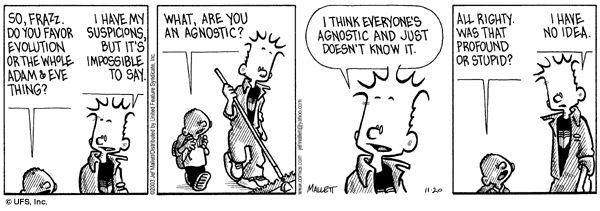
It is always amazing to me how my students and even parishioners, many of whom think they know this story intimately, have never noticed that God, realizing the Man needs a helper, begins with animals and not with the woman. It doesn’t take long, however, to see why the story moves in the manner that it does. It is not, as I cheekily imply in my sub-title, that God does not realize what the Man’s needs are. Rather it is the Man who does not yet understand his needs.

Non Sequitur by Wiley

The process of learning is one that is best done experientially. There are some, and I am not one of them, who can hear some fact or be told a truth and they immediately internalize and comprehend it. Most of us not only benefit from being told something but also require the experience of it ourselves. For example, you could describe in great detail would be like to parachute out of a plane but until I do it for myself I won’t truly know what that experience is. Or, more relevant to this discussion, and all too true in my own life, you could tell me how beneficial exercise is and how much better I will feel having exercised on a regular basis but until I have tried it myself (and let’s face it, for the day or so after I first begin taking such advice) I won’t really know the truth of such assertions.

So the Man does not yet realize what he is missing by not having a helpmate. By going through the process of becoming familiar with the animals  the man begins to understand for himself exactly what a true partner or helper should be like. Each of the animals has its own role and can be a comforter or a helper and even a companion to a certain extent for the men. Yet none are his equal.

(more…)


Genesis 2 – The Nature of Man

Gen. 2:7 Then the LORD God formed man from the dust of the ground, and breathed into his nostrils the breath of life; and the man became a living being. 8 And the LORD God planted a garden in Eden, in the east; and there he put the man whom he had formed. 9 Out of the ground the LORD God made to grow every tree that is pleasant to the sight and good for food, the tree of life also in the midst of the garden, and the tree of the knowledge of good and evil. … 15   The LORD God took the man and put him in the garden of Eden to till it and keep it.

Finally continuing on with my occasional series on Genesis I want to avoid working on my SBL paper consider the nature of the Man created. As I mentioned last time, humanity’s origins are basic and organic, we are from the dust of the earth, even if as individuals we are not the salt of the earth. We are not only creatures that God has made, but we are of the same substance as the rest of creation. The plants created in verse 9 come from the earth ‏מִן־הָאֲדָמָה and the animals created in verse 19 are even “formed” from the earth, as was the Man. Yet from the beginning the Man was set apart from the rest of the animals since he contained the very breath of God.

God breathed into the Man life. ‏וַיִּפַּח בְּאַפָּיו נִשְׁמַת חַיִּים וַיְהִי הָאָדָם לְנֶפֶשׁ חַיָּה׃ ” He breathed into his nostrils the breath of life; and the man became a living being.” Man alone of all the creatures made possesses the breath of God and it is this that gives Man life. Humanity alone possesses this unique trait. But what does that mean? Without a detailed discussion of ancient conceptions, it is sufficient to observe that breath is what provides life and is often equated with the very substance of sentience (however it might be conceived).1

While “breath” is often equated with “spirit” in discussing Genesis, it is important to actually read the text. Whereas Gen. 1:2 describes the wind/breath/spirit of God ‏וְרוּחַ אֱלֹהִים hovering over the deep, in this passage it is not רוח but נשמה. So רוח may be appropriately (depending upon context) translated with either of those terms, נשמה is always “breath.” That breath, however, is what animates and gives life to creatures (see HALOT) and the Man received this breath directly from God.

Of course as I write this I feel the need to hedge my comments even further by noting (to myself if no one else) that it is נִשְׁמַת חַיִּים and not, for example, נִשְׁמַת יהוה. This is “the breath of life” so perhaps I should not have said “the very breath of God.” That having been said, I think the act of God himself breathing thus into the nostrils of the Man is unique and distinct. It shows it is not only humanity’s life that comes from God, but our very essence.

So in Gen. 2 we do not find, as we did in Gen. 1, any suggestion that we are in “the image of God” or statements about our dominion over all creation. Instead the Man is a creature created in almost exactly the same fashion as the rest of creation. Almost. All other created things were made after and for the Man and were not given נִשְׁמַת חַיִּים.

The Man was created with an explicit purpose, or at least immediately given a job. “The LORD God took the man and put him in the garden of Eden to till it and keep it.” As I once heard Tony Blair say in justifying government sponsored work programs, humanity was made to do work. The Man’s primary tasks at creation was to maintain and protect the Garden that God had created for him.

Next time I will begin to consider the nature of that work. Teaser: Did you ever consider why this perfect garden needed to be tilled?

life before eve

non Sequitor by Wiley

non sequitur by Wiley

 
  1. But I would be remiss if I did not point out that the biblical curmudgeon Koheleth says, “For the fate of humans and the fate of animals is the same; as one dies, so dies the other. They all have the same breath, and humans have no advantage over the animals; for all is vanity.” Eccl. 3.19 []

“In a total stranger we perceive man himself”

ChestertonThe full quote, from The Club of Queer Trades by G.K. Chesterton, is

Then we [two men having just met] had talked for about an hour about politics and God; for men always talk about the most important things to total strangers. It is because in the total stranger we perceive man himself; the image of God is not disguised by resemblances to an uncle or doubts of the wisdom of a moustache.

Given the recent discussions about the image of God lately, it struck me. I like the way that Chesterton equates “man himself” with “the image of God.” I also like notion that we can be distracted from seeing God in others by their moustaches or other such appearance.