Targuman Rotating Header Image

Targum

“Inventory of Structurally Important Literary Features in the Anonymous and Pseudepigraphic Jewish Literatures of Antiquity”

This is an exciting project that our colleagues at Manchester and Durham have been working on. News from Alex Samely:
Dear Colleagues,

I have pleasure in announcing the availability of a new terminological framework for the analysis of ancient Jewish literature, the “Inventory of Structurally Important Literary Features in the Anonymous and Pseudepigraphic Jewish Literatures of Antiquity”.

This Inventory gathers together all the basic literary options available to ancient Jewish text makers and puts them into a systematic order. It is available in PDF and web-based formats from:

www.manchester.ac.uk/ancientjewishliterature

The Inventory identifies literary structures found in any one of the anonymous or pseudepigraphic works of ancient Judaism. The corpus on which the Inventory is based includes the Pseudepigrapha, the Apocrypha, the Dead Sea Scrolls (only near-complete texts are included), and rabbinic literature to the end of the Babylonian Talmud.

Several hundred features are defined and organized in a systematic order under twelve main headings. Each feature is illustrated by one or more ancient text containing it.

The categories reflect insights drawn from a large variety of modern disciplines, including philology, literary studies, text linguistics, discourse analysis, narratology and post-structuralism.

The Inventory is the first major result of a four-year research project funded by the AHRC which started in 2007 at Manchester and Durham Universities.

The website also has a discussion forum. Scholars are invited to share observations on, and experiences with, the Inventory or related questions.

A Database of literary Profiles is being prepared which applies the Inventory to individual texts from the Project corpus. Scholars may be given pre-publication access to the Database if they wish to create a Profile, under their own name, for a text with which they are concerned. Please get in touch with me if you are interested in this.

There will be a workshop on problems in the literary analysis of post-biblical Jewish literature in Manchester on 11-12 July 2011. The workshop will be discussion-based, but also introduce the use of the Inventory and of the pre-publication Database for sample texts, including texts suggested by participants. The workshop is open to colleagues, post-docs and postgraduate research students working on any ancient Jewish or related text. There is assistance with travel costs and accommodation is free. A document is attached containing further details and a registration form. It is also available from the Project website:

www.manchester.ac.uk/ancientjewishliterature.

Yours,
Alexander Samely

Alexander Samely
Professor of Jewish Thought
Co-Director, Centre for Jewish Studies
Middle Eastern Studies / Languages, Linguistics and Cultures, Samuel Alexander Building
The University of Manchester, Oxford Road, Manchester, M13 9PL, UK
Tel. (0)161-2753072
Research Project: http://www.manchester.ac.uk/ancientjewishliterature/
Midrash Database: http://mishnah.llc.manchester.ac.uk/home.aspx


Targum: Preserving “God’s Word”

In the comments on my previous post Joel asked about the origins of the “theologizing” in Targum Ruth. This morning he further commented,

I’m just now getting into 2nd Temple lit, but the Targums fascinate me, especially as a tradition in which a traditional text was developed for a specific purpose and accepted without what we know of today as reactionary calls of ‘changing God’s word.’

Joel brings up some good points about Targum. (A month ago I posted a basic definition of Targum and I refer you to that.) The specific origins and use of the Targumim has generated a fair amount of debate, particularly in scholarship lately. There are three likely contexts in which the Targumim were used: the synagogue, private study, and in the Bet Midrash (school). The origins, however, likely go back to synagogal use. If I may quote myself from the Dictionary for Theological Interpretation of the Bible:

The origins of the Targumim can probably be traced back to the liturgical practices in the synagogue. The Mishnah (c. 200 AD) states that the reading of the biblical text in a synagogue was to be accompanied with an appropriate translation so that all might understand the text being read (m Meg. 4.4). Rabbinic texts make it clear that the meturgeman, the one who translated the biblical text into Aramaic during the synagogal service, was not allowed to read from a written text, so that the congregation would not confuse the translation with the actual holy, written word. This leads to the possibility that the physical texts that we study today may not, in fact, represent the actual targum as recited in the synagogue. Nonetheless, the written targumim that we can study share this same respect for the Bible as God’s word and exhibit this in the nature of the genre.

So to Joel’s point, while we may not know if there were “reactionary calls of ‘changing God’s word’” there were clearly barriers and delimiters put in place so that the God’s word would not be change or confused with the Targum. In that sense I think that there were definitely concerns that Scripture remain unchanged. Remember, the whole reason for the Targum was to preserve the reading of Miqra/Scripture in Hebrew long after Hebrew as understood by the congregation hearing the words read aloud. Far from changing Miqra, Targum ensured that it could be crystalized.

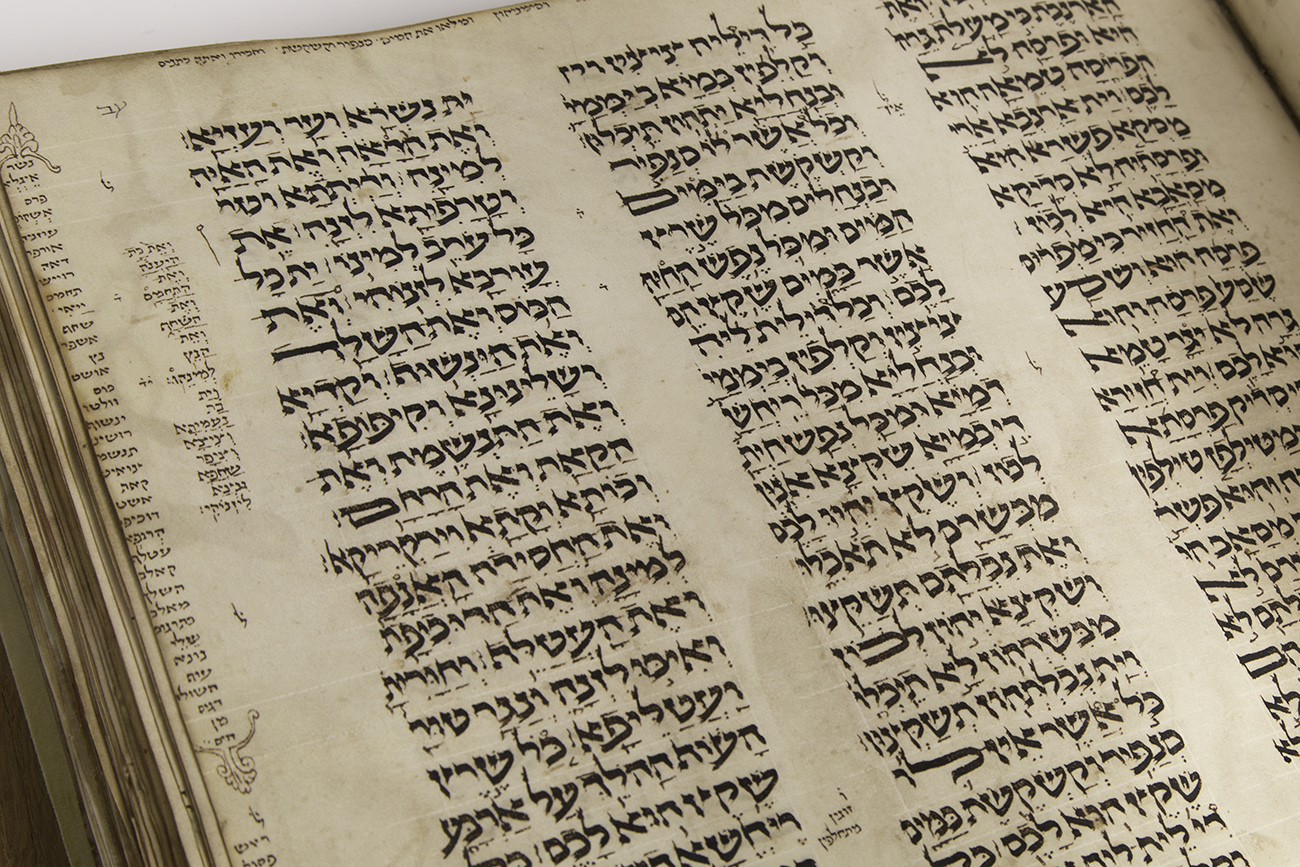
Furthermore, Targum was never to exist without the Tanakh (although one can read a Targum and it is fully comprehensible without the source text), in fact, we discussed at IOTS how many and likely most manuscripts have the biblical text right there in the Targumic manuscript, usually alternating verse by verse with the Aramaic, although some are in parallel columns. (See the image below of TgLam 3:18.)

The result is that the community was able to both preserve Scripture without any alterations while providing a comprehensible rendering (in the linqua franca)1 and commentary. We might compare it with a Christian congregation today where the passage from the Bible is read and then the preacher offers their “rendering” in a more colloquial English followed/interspersed with the sermon. Not a precise analogy, but I think you get the idea. The Bible is still sacrosanct, but the need to translate (even the English translation!) and interpret is recognized.

Solger MS of TgLam

TgLam 3:18, Solger MS

 
  1. Although I want to be quick to note that the Targumim continued to be read and studied in communities long after Aramaic ceased to be understood. In that sense, they themselves passed into a kind of sacred status. []

The character of Boaz in TgRuth…so what?

You know, of course, that last week was the IOTS and I presented a paper on Boaz in Targum Ruth. I was going to post my paper here, but I have changed my mind. (I will post the audio as a podcast later today.) I realized that the paper is so long folks are unlikely to read it all and I will submit the whole thing as an article later this year anyway, so that can wait.

The Chair

On the other hand, I did want to share my basic conclusions as well as my thoughts on why such a study matters. The final few paragraphs of the paper will suffice.

So how has the character of Boaz changed in the Targum? His character in terms of his moral qualities remains positive, but any questions that might have existed, such as those put forward by some modern scholars, are eliminated as his reputation is now beyond reproach. But the character of Boaz within the story, the figure within this moral tale, has changed quite dramatically. He has gone from a relative unknown “prominent rich man” to becoming the epitome of the judge and sage. He is the man that all should seek to emulate.

And that brings us to some final observations. What has been done thus far is quite simple. I have set the texts next to one another and looked for the differences, to see how the Targumist has changed Boaz in his rendering of this text, and offered a simple systematization of those differences and changes. But what of it? Any such survey is mere data collection unless we reflect upon the evidence and draw some conclusions.

The first is that based on content alone we can suggest that TgRuth, if we had any doubts, is in its current form a late text. While one should always be cautious when suggesting primacy of exegetical traditions, we can say with relative certainty that in the case of TgRuth the interpretive traditions found in the Targum are well established in other and likely earlier texts. In fact, many of them such as the reference to Boaz as Ibzan seems to presuppose the audience’s knowledge of the tradition. Certainly the ruling of the sages placed in the mouth of Boaz did not originate in the Targum.

The Targumist was able to choose from a broad preexisting corpus of exegetical material and yet was relatively conservative in what was included. So why did he choose to include the reference to Joseph and Paltiel but exclude the tradition that Boaz dies on the night of his wedding? A complete answer will require a lot more thought on my part and is the primary subject of my book, but a few preliminary comments can be made now.

Whereas the biblical text was, in many ways, seeking to answer the question, how it is that King David came to have a Moabitess as a great grandmother, the Targum has become a rabbinic moral tale. Where the biblical text shows the faithfulness of Ruth to Naomi, the Targum presents her as the prototype of a proselyte. In short, each addition to the biblical text was chosen by the Targumist to exhort his audience, whether it was used for personal study, in the school or synagogue, to strive to follow the example of Boaz to be a righteous man, strong in the Law and faithful to rabbinic precepts.

If you think about it, there are quite a lot of studies out there in our field(s) that do a great job of presenting data, but rarely drawing conclusions. In my specific niche of Targum studies I think that such questions are very important for understanding what is really going on in the Targumim. Of course Ruth and the other Megilloth are small enough that the Targumist would have been able to frame and structure an overarching exegetical agenda throughout the entire work. The Targumim to the Pentateuch, for example, are not likely to have the same traits, at least not over the entire book of Genesis, for example. On the other hand, Avigdor Shinan has shown that we do find such exegetical strategies being played out over a given Parashah.

So what?

Always a good question to ask of ourselves when we get to the end of a paper, book, argument, or sermon. Don’t you agree?


IOTS call for papers!

This came in the email as a reminder and boy did I need it! The deadline is TODAY! I am going to guess that since it was just sent out again we may have some leeway, but please submit them soon!

International Organization for Targum Studies
Sixth Meeting
HELSINKI, FINLAND
August 4-6, 2010

CALL FOR PAPERS

The 6th meeting of the IOTS will cover a wide range of topics related to
Targum Studies:

Philology;
Typology and Genre;
Translation Strategies and Theory;
Exegesis;
Theology;
Text-criticism and Manuscript Studies;
Relationship to  Rabbinic Literature.

We are pleased to announce a call for short papers in any of these categories.  Papers should be of twenty-minutes length, allowing ten additional minutes for discussion. The deadline for paper proposals is September 15, 2009, and March 1, 2010  for the submission of written abstracts.

DATE
The sixth meeting of the IOTS will be held from August 4-6, 2010 in conjunction with the XXth Congress of IOSOT, the International Organization for the Study of the Old Testament, and other specialized congresses (IOQS, IOSCS, IOMS), to be held from 1st to 6th August 2010 in Helnsinki, Finland. All information on these congresses, registration, accommodation, etc. can be found on http://www.helsinki.fi/teol/pro/iosot/abstracts/iosot.htm.

PAPER PROPOSALS
If you are interested in participating and presenting a paper, please send your proposal (title and/or subject of paper) to:

Dr. Willem Smelik,
willem.smelik@ucl.ac.ukwillem.smelik@gmail.com

Dept. of Hebrew and Jewish Studies
University College London
Foster Court, Gower Street
London WC1E 6BT

Please forward this call for papers to any student or scholar you think may
be interested.


New book on Targum Jonathan

I received a note from friend and colleague Dineke Houtman about the publication of a new projection on the origin and history of Targum Jonathan. This book was a collaborative project with Harry Sysling and is being published by Brill. Volume 9 in the Studies in the Aramaic Interpretation of Scriptureseries, Alternative Targum Traditions The Use of Variant Readings for the Study in Origin and History of Targum Jonathan is available from Brill now.

The present study explores the possibility of using variant readings of the Targum of the Prophets to get a better insight into the origin and history of Targum Jonathan. The focus is on two sorts of variant readings: the Tosefta Targums and the targumic quotations in rabbinic and medieval Jewish literature. The chapter on the Tosefta Targums concentrates on variants from the book of Samuel. The chapter on the targumic quotations includes quotations of all the Prophets in early Jewish literature. In the Appendix a full list is given of all quotations of Targums of the Prophets presently known. The book is useful for the study of the genesis of Targum Jonathan as well as for its later developments.

Congratulations to Dineke and Harry! This will be a great resource for all interested in targumic studies and exegetical traditions.