As I (finally) begin to write about the character and nature of God as found in Genesis 1 I realize that I have written extensively about this topic in a slightly different context. “Characters of God” was a post from two and a half years ago and is a first chapter of a devotional work I hope to someday finish. Work and more academic papers have kept me from pursuing that project but this series is on outgrowth of my interest in the subject. Now, to consider Genesis 1 and the character of God.
Given that God is the subject of almost every verb in the opening creation story of Genesis it is surprising that God is never provided with any sort of description or introduction. It is left to the reader to deduce from the text the nature of this creator from the text. I have already alluded to various traits about God that I believe are evident in the text, in the shape of the narrative and its subject matter.
Let there be…order
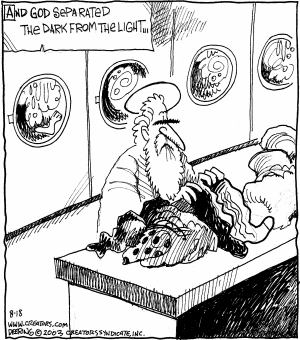
God is, clearly, the source of all creation. Whether ex nihilo or otherwise 1I recalled a detailed debate about this over at Haggaion and found it today in the archives. Worth looking at it even thought Jim West’s links are dead since his old blog was hacked. the author of Genesis 1 clearly presents God as the origin of all that exists in our world, most likely even the pre-existent earth and waters. God’s power is evident in the fact that the world is created by his decree. To say that God is “omnipotent” seems redundant; God’s power is complete and all creation flows from it. God does not need to use intermediaries to achieve his creative goal, the elements respond to his very word. The divine decree is rightly compared to that of a king, who merely speak and a servant carries out his whims. But in this case there is no page or lackey involved; God calls for light and it is kindled.
“A clean desk is a sign of a disordered mind.” Maybe, but an orderly creation is the sign of a thoughtful God. The very order of creation in Genesis 1 is intended to convey not only the power of God, but also reassures the audience that God is an orderly God, that is, God is not capricious. While John Hobbins and others have pointed out that the order of creation Genesis 1 presents a kind of “scientific” view of the world 2A recent article by a PSU colleague was brought to my attention by my research assistant. He makes this very argument on a comparative basis. Halpern, Baruch. “The Assyrian Astronomy of Genesis 1 and the Birth of Milesian Philosophy,” Pages 74-83 in Eretz-Israel 27 (festschrift Hayim and Miriam Tadmor). Jerusalem: Israel Exploration Society, 2003. (and there is also the literary symmetry to consider), as a reflection of God’s nature an orderly creation indicates that God is not engage in some willy-nilly experiment, he is not reacting to some external threat or force and God (and creation) is not random.
This order, we might also say, reveals that God is reasonable or rational. Such terms run the risk of being limited by our view of reason and rationality since, after all, God is reason itself. If I may quote my earlier post referred to in the opening paragraph, when we consider what it means that we are made in the image of God, one characteristic that becomes clear is our ability to reason.
Our intellect, our ability to do more than problem solve, but also to ruminate, contemplate, and meditate further sets us apart from the animals and is a result of our being created in the very image of God. Humans alone consider and propose theories as to how we came to be and, more importantly, why we are here. This is the heart of reason, to seek the explanation, the why of this, that, and everything. God is reason. He is the explanation of all questions. To put it another way, God is the reason (noun) and by creating us in his image he enables us to reason (verb) therefore whenever we exercise the faculty of reason we are in fact seeking God. Newton, Darwin, Einstein, were each reflecting and seeking God’s image as they considered not just how but why things happen as they do. When Christians debate the mechanics of Creation, asking did God use evolution as a means to bring about life or did he simply speak and the life instantly appeared, we know that whatever our conclusions the answer is God. No matter how he did it, it was God who created this world.
So far and yet so near…
It is often rightly said that God, as depicted in Genesis 1, is transcendent. That God is “beyond or above the range of normal or merely physical human experience” is perhaps an assumption but when compared with the description of God literally getting his hands dirty in the creation of the man in Genesis 2 the divine voice heard in the first chapter does seemed thoroughly distant. But I wonder if transcendent always means distant. To give you a recent example of how God is conceived as transcendent in the first chapter consider Daniel McClellan’s post to which I have referred before.
Gen 1’s deity is a transcendent being far removed from the frailties of humanity. This squares with the universalization of God following the collapse of Jerusalem and foreign rule. I think this was not necessarily meant to be explicit in the text, but rather a subtle allusion to an updated perspective on deity, which probably followed a slow theological de-anthropomorphization.
I will try not to wrestle directly or solely with Daniel’s comments but they serve as a useful hook upon which to hang this discussion. While it is true that Genesis 1 depicts God as non-anthropomorphic, it runs deeper than that. In fact, the whole challenge of this post (and undoubtedly the next) is trying to describe God at all given the paucity of details provided in the text. Explicit in the text we know that God is אלים, that the male gender is used for conjugation and pronouns, that his spirit moved, 3I honestly do not understand why people insist on the translation “a wind from God.” and that he created-ordered the world through declaration. So while we do not have a description of God walking, nor do we have a corporeal presence described we are told that God speaks (not only in creative acts but in conversation with Humanity, male and female Gen. 1:28-30) , he sees (that it is good), and his spirit moves. Are these any less “immanent” than God “forming” the man and breathing into his nostrils? Is God really any farther from humanity?
It is clear that Genesis 1 is an introduction not only to the Book of Genesis but the “canon” (whatever form that might have been at the time) as a whole. There is general agreement from all but the most conservative that this chapter was written after much of the rest of the Pentateuch, so assuming the author/redactor’s knowledge and acceptance of Gen. 2-3 can we really assert with such confidence that in chapter 1 God is being re-presented as something very other than the LORD God in chapters 2-3? Is it not more likely that it is not an either/or proposition but rather that the author is broadening the audience’s view of God? In which case this is not so much “God is in heaven and you are on earth” as it is an assertion that God is both without and within. His spirit flutters over the water, there is presence.
Certainly the most useful discussions of the nature of God depicted in Genesis 1 will come from a comparison with humanity since we were created in his image, in his likeness. And that is where I will begin next time.
- 1
- 2A recent article by a PSU colleague was brought to my attention by my research assistant. He makes this very argument on a comparative basis. Halpern, Baruch. “The Assyrian Astronomy of Genesis 1 and the Birth of Milesian Philosophy,” Pages 74-83 in Eretz-Israel 27 (festschrift Hayim and Miriam Tadmor). Jerusalem: Israel Exploration Society, 2003. ↩︎
- 3I honestly do not understand why people insist on the translation “a wind from God.” ↩︎








8 thoughts on “Genesis 1 – Character of God”
W/r/t to footnote #3, it probably has something to do with divine flatulence. I’m not sure I agree with your preference for “spirit of God” over “mighty wind” (reading אלהים quasi-adjectivally) but I have another class in 24 minutes and can’t think too hard about this question right now.
My sides hurt from laughing so hard. I was talking to my wife when this popped up and she hung up on me because I was laughing. (“Sad Bible boy humor” she called it.)
I don’t know
to me the character of God cannot be fully explained even though us as humans feel the need to constantly explain everything which is deffinetly a major downfall we have in trusting God.
God is everything good. He’s changeless, powerful, sovereign, measureless, strong, steadfast, merciful, graceful, and so many other things it would take me forever to say even half of them.
He’s everything we need and everything we strive to be.
Thank you Sarah. In many ways I agree with you, we cannot fully know, let alone explain, the full character and nature of God. Yet There is still great value in making the effort. It is a kind of meditation, where contemplating God helps us to better understand ourselves.
ultimately i think God does want us to make that effort but we just have to know that it is truely impossible to know. Im reading a book right now in my bible class called “Bible Doctorine” and the most recent chapter i’ve read explains how we try so hard to know God but even trying to completely understand one tiny thing about him is more than our minds can handle.
Like we say we understand God’s love, but truely thats so beyond what we know.
He loved us so much he gave His son! Now to completely understand why and how much strength that took could go on and on because there is so much depth to it!
To understand why He would take us back after all the terrible things we’ve done to him..
Its incomprehensable.. Thats one of the many reasons we need faith.
We trust that what God’s word tells us is truth because God is ultimately good. There is no wrong in Him and scripture is “God breathed” so we don’s have to sit here and wonder, “why does God love me?”, we just trust and know that He does! 🙂
i have been thinking about created in ‘His image’ If we are made in his image then he must in some ways be like us. Particularly in feeling, thinking etc. This is new for me , I had mostly thought of God far removed , more of a transcendent being. He is also so personal.