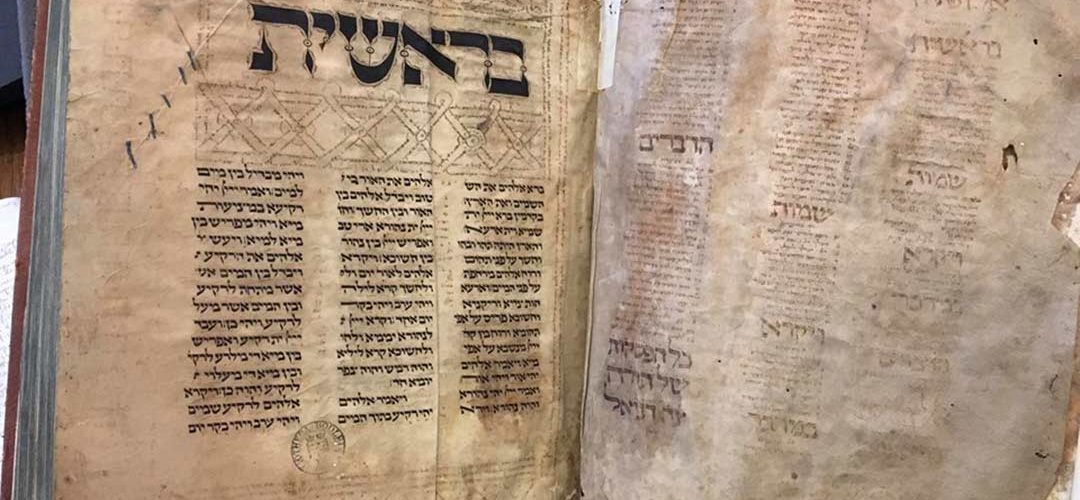
I was invited by Rabbi Kozberg to speak at this year’s Rosh Hashanah service at Temple Sholom in Springfield, OH. The Torah reading is Genesis. 22.
Good morning. It is such an honor and a privilege to be with you this morning and to be invited to speak, particularly on Rosh Hashanah, the beginning of ימים נוארים. Our passage this morning is the quintessential story of faith, as Abraham obeys God’s command to go and sacrifice his son – his only son, the one he loved – in light of God’s promises. In Christianity, Abraham is referred to as “the Father of Faith.” Perhaps, before I go any further, it is appropriate that I should share my journey of faith, how a guy named Christian is standing here speaking to you on your holy day.
I grew up in a Presbyterian church, very evangelical in character, which in those days meant something very different than it does today. Then, it meant that our pastor preached, not theological frameworks or political policies, but directly from the Bible. What today I would call “expository preaching.” We were encouraged to bring with us a notebook, pens, and even highlighters to mark up our Bibles and our notes. The Presbyterian church is part of the protestant tradition, so worship was very plain in nature although filled with music.
In college, I began to study the Bible more deeply, in an academic way and I studied under Dr. Gary Rendsburg, a Jewish scholar who today is very close mentor and friend. I also began to study medieval history and consider how Christians then worshipped and interpreted the Bible. This in turn, eventually, led me to become an Episcopalian. That and marrying an Episcopalian. The Episcopal church has bishops (“episcopacy”) and many of the styles and structures of the Roman Catholic church but is protestant in theological teachings. My studies, however, led me deeper into the Jewish interpretation of Mikra.
So it was that after more years than it should have been, I had completed two masters degrees and a doctorate, focused upon the rabbinic interpretation of Scripture, with a particular emphasis upon Targumim, the Aramaic version of Tanakh that come from the first 800 years of so of this era. My upbringing under a preacher who carefully read every word of the holy text, led me to study how the original preachers interpreted and kept alive and relevant Mikra, for generation upon generation. My doctorate, for example, was a study of how Targum Ekhah, the Targum of the Book of Lamentations, sought to continually understand how God could have allowed the destruction of Jerusalem, and all other calamities that have befallen God’s people before and since.
My academic career began as Director of Jewish Studies at Tulane University, where the most commonly asked question was, what’s a nice Jewish boy like you doing with a name like Christian?, to today I serve as the President of Wittenberg University, a school with deeps roots in the Springfield community and the Lutheran faith.
Faith is such an odd word, really. It can refer to a religious tradition, a set of practices that may have nothing to do with belief in any particular set of ideas other than simply doing things the way they have always been done. The deeper meaning is having confidence in someone or some idea or concept to such an extent that it shapes our lives, directs our actions. Faith is often used, however, to disparage, to imply that we believe something in spite of no evidence or even all evidence to the contrary.
A first-century Jewish writer defined faith as, “the assurance of things hoped for, the conviction of things not seen” (Heb. 11:1). That author, that preacher was reflecting on the accounts in the Bible of our (shared) ancestors’ confidence in the promises of God. In the Akedah, our reading this morning, we hear this familiar story of faith, as Abraham obeys the word of God.
It is familiar, the story, it is perhaps too familiar, because when you think about it for just a moment, it is appalling. How could God possibly ask a father to slay his son?קַח־נָא אֶת־בִּנְךָ “Take your son, your only son Isaac, whom you love, and go to the land of Moriah, and offer him there as a burnt offering on one of the mountains that I shall show you.” Even if we read the “na” as a request (as Rashi does), “please,” the verb is in the imperative form, “Take!” As I have found in the last year, the position of the speaker changes the force of the words. If the president of the university asks if we can have coffee after lunch, the answer is not “no.” When God is speaking, there is force in the request.
All the commentaries wrestle with this, from the Midrash to the Babli to Rashi to Kiergegaard. As you know, rabbinic commentary parses out and examines every word of the biblical text. They do so, in part, because the biblical text is often so sparse. We are never given any insight into Abraham’s thoughts, let alone Isaac’s. But we can imagine…and our hearts quail.
We must remember that God’s request comes to Abraham after a long life, with various moments of God speaking with Abraham, telling him to leave his home to go to another land, promising him, against their age and biology, that he and Sarah would have a child, and the promises that his descendants would be more numerous than the stars. That is the image I always grew up with, of God walking beside Abraham on all those dusty miles, chatting away, pointing with a sweep of his mighty arm, “See! Someday all this will be yours and all this land will be covered with your children and your children’s children!” Yet, if we do the math, if we realize how long we are told Abraham lived and how few the conversations are that they had, most of the time Abraham, Sarah, and his family were left to get on with it. Decades would pass with no reported contact from God.
If we were writing it as a novel, as one of my favorite authors Frederick Buechner did in The Son of Laughter, we would add all sorts of detail. We would consider what the characters were thinking, feeling, fearing. Like the rabbis, Buechner sought to get deeper into what it would have been like to be Jacob, to inherit the promises and the problems of being the son of Isaac, the son of Abraham. At one point, Jacob, who names God “Fear,” describes what it’s like to hear God speak. “The Fear came to me in the night and whispered words of hope into my ear. He told me that he loved me as he had loved Laughter, my father, before me and Abraham, my grandfather, before that. He repeated the ancient promises that never fail to frighten me with their beauty just as the Fear himself never fails to frighten me.”
The text of Genesis is quite sparse. In the Bible as a whole, it is very rare to find any reference to the inner life of a figure. This is due in part, of course, to these stories having been written long ago in cultures and places with very different styles and expectations than our own. But it is not a lack of style or a deficiency in the literary quality of Genesis. It is its power.
God said, לֶךְ־לְךָ “Get up and go to the land that I will show you.” And “Abraham got up and went.” God calls out Abraham’s name, and he replies הִנֶּנִּי “Here I am.” We want to know more, we want to know what it was like, as Buechner’s imagination of Jacob expresses it, to hear the voice of God; it must be one of the most frightening things imaginable.
We want to know…
That is the human condition, isn’t it? We want to know? We want knowledge, we want certainty, we want assurances. From the very first test of all, “God knows that when you eat of [the fruit of the tree] your eyes will be opened, and you will be like God, knowing good and evil.” To Moses’ insisting, “Who am I that you should send me?”
And note that God says to Moses, “this shall be the sign for you that it is I who sent you: when you have brought the people out of Egypt, you shall worship God on this mountain.” I don’t know about you, but I usually expect the sign that I should do something as coming before the act I am to perform. I like my assurances up front.
We want to know… and faith, faith is all about acting before we know.
The Days of Awe lead to Yom Kippur, the Day of Atonement. This is the beginning of a time of reflection and repentance. What does this story of Abraham’s faith and obedience tell us of repentance, of seeking forgiveness?
Repentance is about giving up, giving up of those things we often most hold dear, so that we can move forward. Sometimes the things we most hold dear are, in fact, our very sins, the things we know we ought not do, but in some way, we find they identify us, give us purpose and meaning.
All things must be given up to God so that we walk in faith. Having given them up, we may well receive them back from God, more blessed and holy than they could ever be so long as we hold on to them.
Søren Kierkegaard, the (Lutheran) philosopher and father of existentialism reflected upon the Akedah and concluded that it allows us “…to see what a tremendous paradox faith is, a paradox which is capable of transforming a murder into a holy act well-pleasing to God, a paradox which gives Isaac back to Abraham, which no thought can master, because faith begins precisely there where thinking leaves off.” (F&T, p. 106)
The story of Abraham is the story of God’s promises to his people. Remember, God’s demanding request of Abraham to sacrifice his son comes after God’s many promises to bless him with countless children. The path towards the fulfillment of God’s promises will take you many places, often to places that you don’t expect, that even seem to be completely counter to the destination. Yet the promises are assured; God is faithful.
We are assured of God’s promises, if not the path. לֶךְ־לְךָ Walk on.