Targuman Rotating Header Image

Academics

Connecting to younger generations

Andy Capp by Reg Smythe

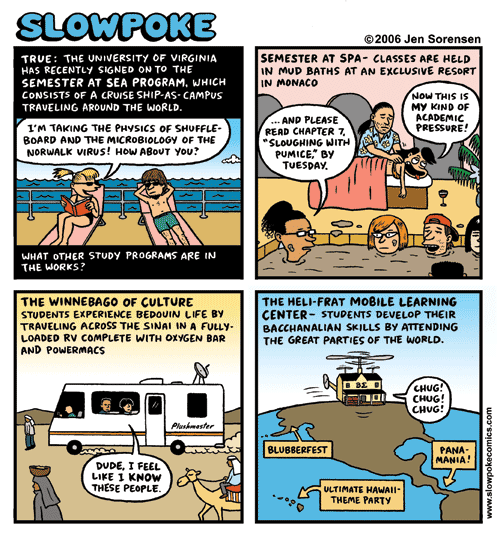
It is tough to admit it but I am no longer the “younger generation.” Sure I use twitter, facebook, and often have the gadgets. Folks are saying that twitter and facebook are really for the old folks anyway so maybe that isn’t a sign of my hipness. But when it comes to education and preaching I think that we are very often in danger of altering the message rather than the means of delivery. When Paul said he became all things to all people (1 Cor. 9:22) he was not saying that he would alter the Gospel to meet a different audience’s perspective (if they didn’t like the idea of Christ’s death as an atoning sacrifice, for example, he did not say that it was merely an example of love). Rather he was saying that he would meet people where they were in the condition that they were in. The Bible must be translated into every languages and only some of them are verbal.

This is true for education as well. I certainly believe that we need to understand the nature and character of our students today and we should explore modes of delivery that will work best for our/their current context (which is not the same for everyone, we have commuters, adult learners, military, etc.). But our goals and the content should not necessarily change. The obvious exception to the content is, of course, where new knowledge is being developed; we need to stay up-to-date in our fields and incorporate new discoveries and theories into our courses. As much as I am glad to see folks using the iPad, for example, in English classes, I worry sometimes that in some people’s rush to incorporate the latest gadget they are not only potentially leaving some behind they are also running the risk of making the course about the tools rather than the subject.

In short, whatever modes and methods we use we need to keep our eyes on the “course objectives and learning outcomes,” even in the church.


Off to Finland and IOSOT!

Boarded and getting ready to take off. Next stop Frankfurt and then Helsinki.


“Academic and Publishing Freedom”?

That is the title of this Inside Higher Ed article about Christianity Today’s Books & Culture rejected an article questioning the past and future direction of Wheaton College. As someone with an MA from Wheaton I thought I might make various trenchant comments, but I will not. Just a couple of notes about the IHE article and a pointer to the article in question. Here is the basic info about the critique:

The author — Andrew Chignell, a Wheaton alumnus who is associate professor of philosophy at Cornell University — has just published the article online, along with “the back story” about how the piece was killed.

From a quick read of Chignell’s article it looks very fair to me, so give that a glance. But to turn to the IHE article I wanted to make two points. The first is minor, but annoying. Throughout the entire piece, aside from when they are quoting Chignell, they consistently misspell the Wheaton President’s name as “Liftin” instead of the accurate “Litfin.” Is it that hard to get someone’s name right?

Finally, their title is more than a bit misleading. While I do not agree with some of the directions in which Litfin has taken Wheaton he is no shrinking violet. He and the college did not, and Chignell affirms this, try and kill the story. The decision was made by Christianity Today International’s president. As Litfin told IHE,

“Even if I had the ability to stifle the article, I would not have done so,” he said. “It goes against the grain of everything I believe.”

He added: “I disagree with the article, but I don’t think the article is something we need protection from.”

So this was not a story about academic freedom, as implied in the title (but I note their insertion of “and publishing), rather it is simply an editorial decision by a private publisher. I don’t agree with CT’s decision, it was petty, shortsighted, and unnecessary, but that is their right. No doubt IHE was trying to generate interest in a story that would otherwise have a rather small audience. Still, I think the title is misleading.

UPDATE: There is a great comment on the IHE thread by David Wright , Provost at Indiana Wesleyan University. Well worth reading.


Updates: BS Carnival & Top 50

top_501.jpg

Being the end of the month (or now the beginning of the new month) we have our monthly Biblical Studies Carnival and Top 50 blogs listing. Doug Chaplin aka clayboy did an excellent job with this month’s Carnival. This month I moved back into the Top 50 biblioblogs after a brief hiatus (not posting is an excellent way to drop down the ranks).


New book on Targum Jonathan

I received a note from friend and colleague Dineke Houtman about the publication of a new projection on the origin and history of Targum Jonathan. This book was a collaborative project with Harry Sysling and is being published by Brill. Volume 9 in the Studies in the Aramaic Interpretation of Scriptureseries, Alternative Targum Traditions The Use of Variant Readings for the Study in Origin and History of Targum Jonathan is available from Brill now.

The present study explores the possibility of using variant readings of the Targum of the Prophets to get a better insight into the origin and history of Targum Jonathan. The focus is on two sorts of variant readings: the Tosefta Targums and the targumic quotations in rabbinic and medieval Jewish literature. The chapter on the Tosefta Targums concentrates on variants from the book of Samuel. The chapter on the targumic quotations includes quotations of all the Prophets in early Jewish literature. In the Appendix a full list is given of all quotations of Targums of the Prophets presently known. The book is useful for the study of the genesis of Targum Jonathan as well as for its later developments.

Congratulations to Dineke and Harry! This will be a great resource for all interested in targumic studies and exegetical traditions.