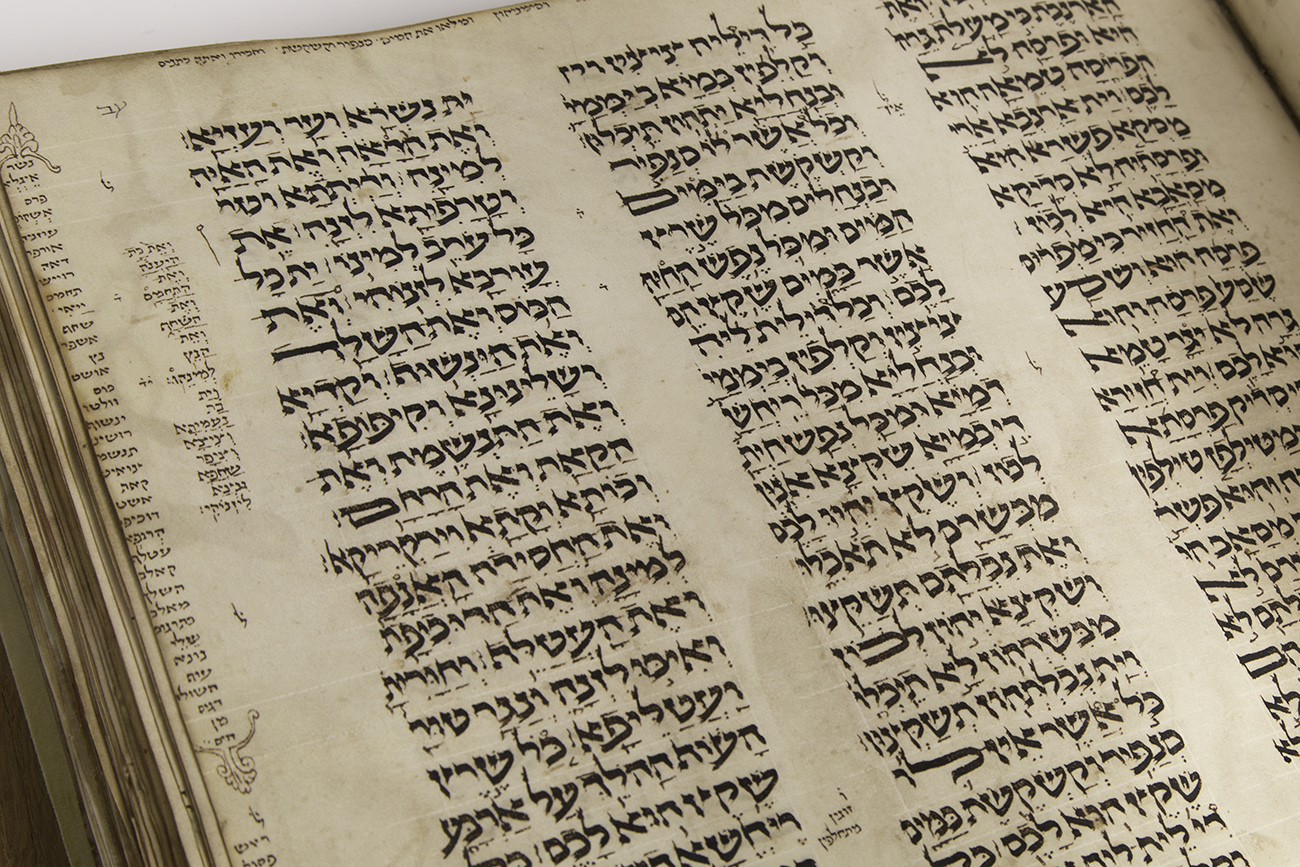
Targuman Rotating Header Image

Targum

Call for papers: International Organization for Targum Studies

We are only a year away from the triennial IOSOT meeting and its associated meetings which includes the IOTS. The Congress will be held at the University of Helsinki and the associated meetings will overlap a bit more this time which should help to reduce costs, 10 days in Slovenia was great, but tough on the budget.

So with the Congress only a year away it is time to announce the call for papers. It is shaping up to be a very good IOTS meeting with Steven Fraade and Dineke Houtman confirmed for two of our three keynote addresses.

Please forward this call and feel free to this link to the Newsletter for Targumic and Cognate Studies site.

International Organization for Targum Studies

Sixth Meeting
HELSINKI, FINLAND
August 4-6, 2010

CALL FOR PAPERS

The 6th meeting of the IOTS will cover a wide range of topics related to Targum Studies:

Philology;
Typology and Genre;
Translation Strategies and Theory;
Exegesis;
Theology;
Text-criticism and Manuscript Studies;
Relationship to Rabbinic Literature.

We are pleased to announce a call for short papers in any of these categories. Papers should be of twenty-minutes length, allowing ten additional minutes for discussion. The deadline for paper proposals is September 15, 2009, and March 1, 2010 for the submission of written abstracts.

DATE
The sixth meeting of the IOTS will be held from August 4-6, 2010 in conjunction with the XXth Congress of IOSOT, the International Organization for the Study of the Old Testament, and other specialized congresses (IOQS, IOSCS, IOMS), to be held from 1st to 6th August 2010 in Helnsinki, Finland. All information on these congresses, registration, accommodation, etc. can be found on http://www.helsinki.fi/teol/pro/iosot/abstracts/iosot.htm.

PAPER PROPOSALS
If you are interested in participating and presenting a paper, please send your proposal (title and/or subject of paper) to:

Dr. Willem Smelik,
willem.smelik @ ucl.ac.uk / willem.smelik @ gmail.com

Dept. of Hebrew and Jewish Studies
University College London
Foster Court, Gower Street
London WC1E 6BT

Please forward this call for papers to any student or scholar you think may be interested.


Targumic source of John’s logos?

I am still not convinced but John Ronning has posted some thought provoking comments to a precious post of mine regarding the date of Targum Neofiti. You will need to read his comments at the post for the details but he concludes:

Diez-Macho (editio princeps) suggested that the erasure of the waw is for the purpose of giving a Christian sense to the verse. Remember that the name “Neofiti” comes from the name of the college established by the Vatican for Jewish converts to Roman Catholicism (i.e., neophytes). Suppose such a 16th century neophyte, while copying from ancient manuscripts, decided that in the very first verse he wanted to give a clue or example to how he thought the Memra should be related to the Logos of John’s Gospel, and so he altered the text by omitting the 4th and 6th words (yyy and mmryh) and switching the 5th and 7th (wSkll and dyyy); then he noticed that he needed to do one more thing to make the verse read “properly” according to this interpretation: he had to erase the waw. the result is that he replaced “Word” with “Son” (by forcing br’ to be a noun).

So to this extent Driscoll is not as far off as he might seem (still mixed up however).

John also has a book forthcoming on the topic and an article that previews the material.

Hendrickson has the last word on the title, which has yet to be determined, but I would like it to be “When YHWH Became Flesh: The Targum Origin of the Logos Title.” I believe John 1:14 is programmatic for the Gospel as a whole, John shows doing in the flesh the same kinds of things he did in OT times in saving his people by divine warfare, revealing his name, coming down from heaven, giving the law, being their bridegroom. My article “The targum of Isaiah and the Johannine Literature” (WTJ, Fall 2007) is a bit of a preview. If you are interested is available athttp://f1.grp.yahoofs.com/v1/8Kc7Spt9Wts62y0WRmIIcJjv4-CmGy8f0QGwK8iwINratquo-iXeqhaDDfn4qHBCJlIDR1Yo_0XwDyrdKuunBtykbCuFwA/Ronning_WTJ-Fall07-topress.pdf

Now I have to get back to correcting my translation of TgLam!


What does the Book of Ruth teach us?

“…the book of Ruth, an idle, bungling story, foolishly told, nobody knows by whom about a strolling country girl creeping slily to bed to her cousin Boaz. Pretty stuff indeed to be called the word of God! It is, however, one of the best books in the Bible, for it is free from murder and rapine.” -Thomas Paine, The Age of Reason Part II (London, 1795), p. 23.

“This scroll tells us nothing of cleanliness or of uncleanliness, either of prohibition or permission. For what purpose, then, was it written? To teach how great is the reward of those who do deeds of kindness.” R. Ze’ira, Ruth R. II 14.

As cited in “Jewish Exegesis of the Book of Ruth” by DRG Beattie, p. 203.


Calling Targum Scholars – Sigla Project

From our beloved IOTS President Willem Smelik:

Dear members of the IOTS and other interested parties,

The IOTS has long discussed the desirability of new editions of (most of) the Targums. A first task, the collection of data on targumic manuscripts, has already started and has come to a promising, even if partial, conclusion at the Theologische Universiteit of Kampen, the Netherlands. Eveline van Staalduine-Sulman came with a proposal for a system of sigla which, if agreed upon and endorsed by the IOTS, could be used in any future studies and editions of the Targums, similar to the sigla nowadays common in the study of the Peshitta. The advantages of a common system are clear to everyone.

At the last meeting of the IOTS it was agreed that we should establish a committee to discuss the format for the sigla of manuscripts, starting with the afore-mentioned proposal. We would therefore like to invite interested scholars to come forward and express any interest that they might have in contributing to this task. The executive body of the IOTS will then discuss the options and decide upon a representative and suitable committee, who will hopefully be able to report their findings at the next meeting of the IOTS in Helsinki 2010.

The contact address is:

Willem Smelik
willem.smelik AT ucl.ac.uk
26 Tenison Road
Cambridge CB1 2DW
UK

With kind regards,
on behalf of the IOTS

Willem Smelik


Lamentations and Tisha b’Av

This past weekend was spent doing various work around that house that required lots of hours and very little thought. Good for the soul, perhaps, but I feel like I lost two days in a wormhole. I missed offering my best wishes for a good observance on Tisha b’Av, so today I will offer instead my presentation from last week’s Catholic Biblical Association. This paper was part of the working group for the Bible in Its Traditions project. It is a very rough introduction to who the midrash and targum of Lamentations deal with this challenging text. I am keenly aware that there is much more material on and relating to Lamentations spread throughout the rabbinic corpus. So, as meagre as it is, here is something in honor of Tisha b’Av.

Rabbinic Reception of Lamentations

I am very grateful for this opportunity to contribute in some small way to the work of this seminar. My work on Lamentations began 14 years ago as I cast about for a subject for my doctoral thesis. My primary interest is in exegesis and so I was directed to consider the rabbis and how they interpreted (and transformed) the biblical text. Specifically, I worked on the Targum of Lamentations. I intend for this to be a discussion of some sample texts but feel I should start by placing us within the context of both Lamentations itself and then within the corpus of rabbinic commentaries.

(more…)