Targuman Rotating Header Image

Ruth

One or Two Articles on Boaz?

I had originally planned two articles on the character of Boaz and subsequently presented two separate papers. The first was on the figure of Boaz strictly within the biblical book of Ruth. The other was on how the Targumist had transformed the figure of Boaz in Targum Ruth. This progression made sense, of course, because one must first deal with the actually biblical text before one can consider how the Targumist has changed or adapted it in the Targum.

At the IOTS conference where I presented the second paper I was encouraged to simply create one larger article that engaged with the entire topic, beginning with the biblical figure of Boaz and moving into the Targumic interpretation. This weekend we have had a wonderful exchange around the topic of Boaz and men in the book of Ruth. In particular Sue of Suzanne’s Bookshelf has had a number of helpful and provocative critiques of my suggestion. Benj and others have contributed as well.

All of this has me thinking that I cannot really flow the one article easily into the other. Certainly the article on TgRuth will take as its basis and allude to my reading of how the biblical book presents Boaz, but to spend 10+ pages wrestling with the biblical text and modern scholarship on this figure to then move into the Targumic (and, referencing more broadly, rabbinic) interpretation doesn’t seem to me like it would flow well. So I ask you, should I do two articles or would you prefer one?


Are Men Marginalized in Ruth?

I am now working on moving two papers I have presented on Boaz into (likely) a single article for submission to a journal to be named later. In re-reading my paper “Boaz Centrally Marginalized” it occurred to me that men as a whole are very deliberately moved to the edges of the book of Ruth. Consider these few points:

  • Is it really all about the women? Perhaps so.

    Elimelech, Machlon, and Chilion never speak, they just die, a key element of the story, but a silent one nonetheless.

  • Boaz reacts he never initiates. As I have argued in that paper, all of Boaz’s actions, even chapter 4, are reactions to the initiatives of Ruth.
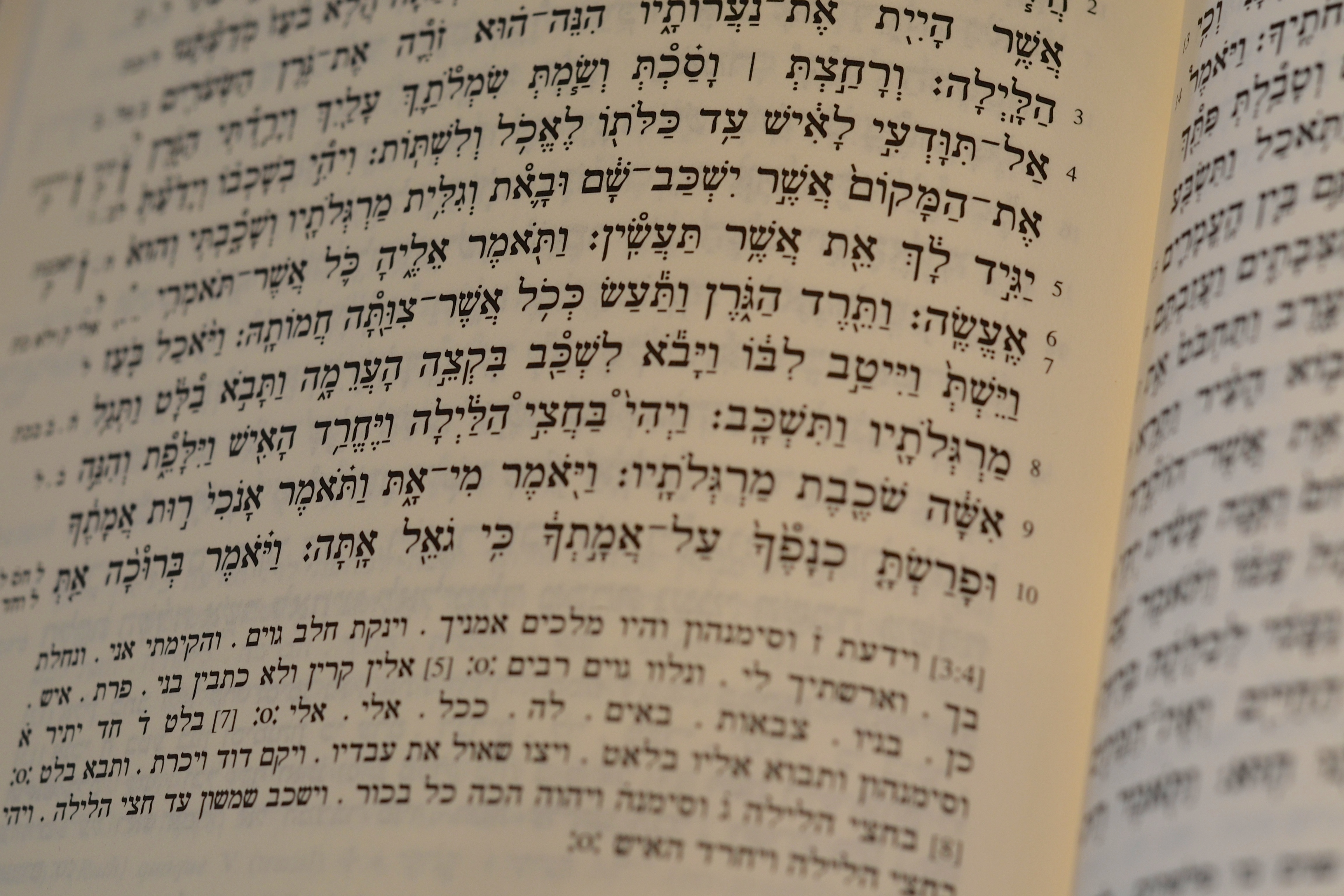
  • The only other important male figure isn’t even given a name, he is simply ‏פְּלֹנִי אַלְמֹנִי, “so and so.”

There are a few other instances where men are given speech (the young men reporting to Boaz and the elders at the gate in chapter 4) but they are anonymous and without any depth or character.

At this point I have read many, many commentaries and articles on Ruth so perhaps someone has already said this and I have either missed it or assimilated it into my own thoughts. What do you think? Is Ruth far more women-centric than we have thought, are the men really marginalized? And are there others who have said this all before that I have missed?


Age in the Book of Ruth and a Proxy Marriage?

It is well known to those who give the Book of Ruth even a cursory reading that Boaz is older than Ruth and, in fact, is closer to Naomi in age. In the comments of a paper on Boaz that I posted here over a year ago, Robert Holmstedt, who has a great book on the subject, Ruth: A Handbook on the Hebrew Text, pointed to some of his own work in which he noted that the “antiquated” language in the book is often in the mouths of Naomi and Boaz.

In my Baylor Handbook I considered 7 features (oddly, I now see that I discussed the paragogic nun elsewhere, although it fits at this point as well) and drew this conclusion (2010:49):

“These seven features are, in my opinion, best understood as part of the story-teller’s creativity and linguistic artistry. And yet they are not simply literary window-dressing. It is no accident that five of the seven features are in the mouths of No‘omi and Boaz, while only one is use in Ruth’s speech. The narrator set up a light ‘linguistic curtain’ with the audiencea on one side and No‘omi and Boaz on the other. The implication is that, while they audience is reminded throughout the Ruth is a foreigner, they are also encouraged, by linguistic means, to identify with her. Although No‘omi is the story’s protagonist and her redemption is an important theological message, Ruth is the heroine of the story and it is her courage and loyalty that the audience is encouraged to take in the most deeply. No‘omi may have been re-filled by God, but God has provided for Ruth across cultural and political boundaries — an important reminder for the Israelites at many historical points.”

(Robert was hoping to produce an article on this for the fall of 2010. Did you get that published Robert? I would love to see it!)

In his Anchor Bible Commentary volume on Ruth, Edward Campbell spends quite a bit of time commentating on Boaz’s age, noting that everyone in chapter two is referred to as being old, in reference to Boaz; the young men, Ruth is a “young woman” (‎‏הַנַּעֲרָה) in Ruth 2:5, and of course Boaz’s “young women” whom Ruth is to follow.

"Oh my gosh! Is that a...woman?!"

In chapter 3 we have the famous scene at the threshing floor when Ruth uncovers Boaz’s “feet.” When Boaz wakes he commends her, saying,

May you be blessed by the LORD, my daughter; this last instance of your loyalty is better than the first; you have not gone after young men, whether poor or rich.

Clearly Boaz is older, perhaps much older, than Ruth. Campbell concludes his musings on this matter by asking, “What purpose is there behind these devices?”

One senses that the story-teller means to give his characters a certain credibility in this way. Perhaps also there is a need, especially in the case of Naomi, to underscore the truth of her own assertion in 1:12 that she is too old to have a husband. As for Boaz there may even be a question about his ability to a sire a son. …In any event, senior citizens they [Naomi and Boaz] are, and the audience should appreciate them as such.1

Keeping this in mind, consider the curious description of the birth of Ruth’s son, Ruth 4:16-7.

Then Naomi took the child and laid him in her bosom, and became his nurse (‎‏וַתְּשִׁתֵהוּ בְחֵיקָהּ וַתְּהִי־לוֹ לְאֹמֶנֶת). The women of the neighborhood gave him a name, saying, “A son has been born to Naomi.”

I have always found the description of Naomi becoming Obed’s “nurse” very odd. True, the Hebrew text describes her as a “foster-mother” (וַתְּהִי־לוֹ לְאֹמֶנֶת) rather than as a wet nurse (‎‏אִשָּׁה מֵינֶקֶת), but the fact that she is described as laying him on her bosom and that they women say a son has been born to Naomi… Well it just makes a fella think.

What I am beginning to wonder is if the marriage between Ruth and Boaz was more of a marriage of convenience than previously thought. We all know that Boaz married her for, on a basic level, the purpose (as confused as the legal situation is) of maintaining the name of Mahlon and providing for these two widows. But when I consider that Naomi and Boaz were contemporaries and significantly older than Ruth (I am not sure I would say that they are “senior citizens” since in our modern context that would mean to most well over 60, something unlikely in the time period) then I begin to wonder if Naomi and Boaz are the real romance and that the women of the town knew that this was the case. Naomi cannot produce a child and Ruth needs to be provided for so and protected so Boaz marries Ruth, but his heart belongs to Naomi.2

I am by no means convinced that this idea has any merit. If Naomi and Boaz were the real love interests, then why did Boaz just not marry Naomi? While Machlon’s name may not have been “preserved” Elimelech’s would have been and the property would have remained in the family. Still, I wonder if these different threads of the story should not be woven together in some fashion….

 
  1. Campbell, pp. 110-1. []
  2. Too schmaltzy? Yes, but this is a blog and as I have noted elsewhere, context allows one to be more casual in some contexts than in others. []

New Translation of Targum Ruth Available (here!)

Targum Ruth 2:4, Solger MS

I am very (very) pleased to post my translation of Targum Ruth. It can be found here and the opening comments and first verse are below. This is a first draft and the English needs smoothing, but I thought I would do a bit of “crowd sourcing.” Feel free to read it and comment. Short of access to Beattie’s edition (see below) if you have the Accordance Targum module 1 then you have the base text or, once it is back online, you may view the Aramaic of TgRuth at CAL.

-=-=-=-=-=-=-=-=-=-=-=-=-=-=-

This is a translation of Derek Beattie’s critical edition, Targum and Scripture: Studies in Aramaic Translations and Interpretations in Memory of Ernest G. Clarke, SAIS 2, ed. Paul V.M. Flesher (Leiden: Brill, 2002), pp. 231-90. The base text is Sassoon 282 (S), which dates to 1182, the oldest MS available. I am grateful to Dr. Beattie for being will to allow his critical edition to be in my forthcoming book as an appendix.2

This is a first pass and does not contain various notes that will be present in the final version. In most cases where words are found in [] and are not italicized they are missing in the MS but are necessary to represent the Hebrew vorlage (MT). In some cases, particularly in TgRuth 1:1, there are words or phrases which are not in S (and are part of an aggadic expansion) but are necessarily for the expansion to make sense. If you have any corrections or comments (or corrections, remember, this is a first pass) please contact the me at cbrady@psu.edu.

The copyright is held by C. M. M. Brady. No use of this translation may be made without the author’s permission.


Chapter 1

1 When the judges led there was a [severe] famine in the land of Israel. Ten severe famines were decreed from Heaven to be in the world from the day of the creation of the world until the time when the King Messiah shall come, to reprove through them the inhabitants of the world. The first famine was in the days of Adam. The second famine was in the days of Lamech. The third famine was in the days of Abraham. The fourth famine was in the days of Isaac. The fifth famine was in the days of Jacob. The sixth famine was in the days of Boaz, who was called Ibzan (אבצן) the Righteous, who was from Bethlehem. The seventh famine was in the days of David, the King of Israel. The eighth famine was in the days of Elijah the prophet. The [ninth] famine was in the days of Elisha in Samaria. And the tenth famine will be [in the future], not a famine of eating bread nor a drought of drinking water, rather of hearing the word of prophecy from before the Lord. And when that famine was severe in the land of Israel a great man from Bethlehem of Judah went out and went to dwell in the field of Moab, he and his wife and his two sons.

Read all of Targum Ruth.

 
  1. This translation will be in the Accordance translation module in due time. []
  2. The images of a TgRuth MS on this site are of Codex Solger MS 1-7.2° (Solger) and should not be confused with the base text used in the translation which is Sassoon. The Sassoon MS is in private hands and I have only a photocopy of a facsimile available and do not have permission to post the images. []

Scatterings: Ruth as Anti-Tragedy

Eric of Scatterings has a nice little piece on Ruth. As you all know, my current research is on Ruth and Targum Ruth. Eric provides a nice rundown of the plot and how the book is exceedingly positive.

There are several points in Hamlet or King Lear where things could get better – where characters might start to understand one another, and the destruction of the characters lives might not be so total. But in a tragedy, these opportunities slip away. The book of Ruth is kind of the opposite of that. It gets better and better and better. Not that Im criticizing Shakespeare, mind you – life is like that sometimes.

via Scatterings: Ruth as Anti-Tragedy.