This is a short commentary on the Book of Ruth that I wrote as part of my preparation for my recent book on the Targum of Ruth. There is more than can and needs to be said (see the tab “Ruth” above for various, related articles) and I will be returning to and expanding this commentary.
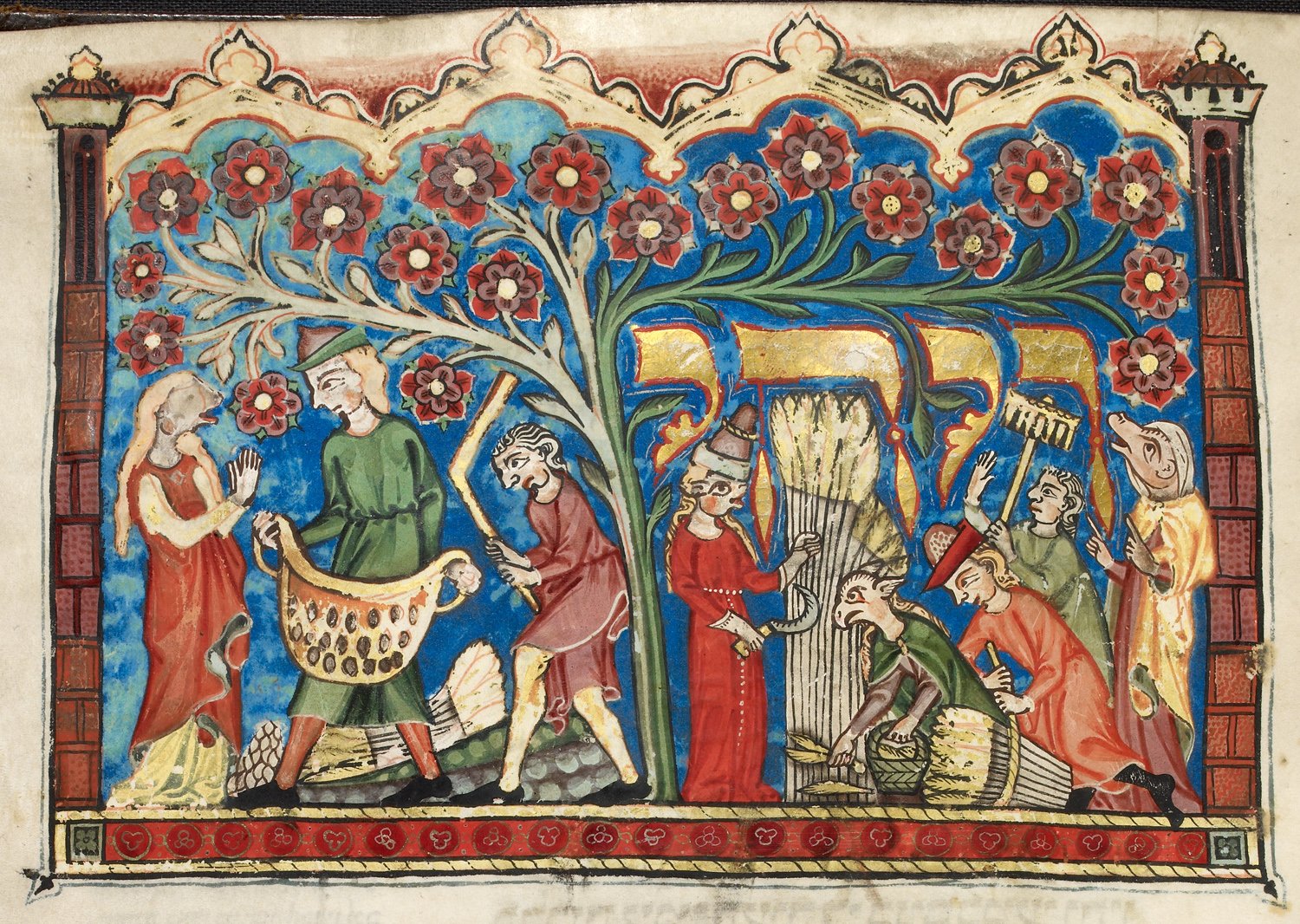
Origin: Germany, S. (area of Lake Constance)
The Book of Ruth
The four chapters of the book of Ruth are often and understandably broken down into four primary scenes, with the actions of each scene driven by different characters. In chapter 1, Naomi is the primary mover, returning to Bethlehem with Ruth and setting off the chain of events on which the book focuses. Chapter 2 opens with Ruth taking charge of the situation and setting out to provide sustenance for herself and her mother-in-law. Chapter 3 is often regarded as being driven by Naomi, for although Ruth is the one who must go out to the threshing floor to confront Boaz, it is Naomi who lays out this plan for her daughter-in-law. Finally, Boaz undoubtedly is the primary actor in chapter 4, though his action is in response to Ruth’s instigation at the direction of Naomi. The primary mover of the entire book then is its namesake: Ruth. While the story starts with Elimelech, by the end of chapter 1 the narrator’s focus has turned to Ruth. She is insistent that she will remain with Naomi regardless of the cost to herself, and it is Ruth’s decisions and actions that drive the story from chapter 2 to the birth of her son in chapter 4 and for generations beyond.
Chapter 1
The book begins by setting the scene, placing the story in “the days when the judges ruled” and when a severe famine has come upon Bethlehem. It opens with Bethlehem, “the house of bread,” in famine while Elimelech and Naomi’s family is “full” with their two sons. The narrative pivots when the family is left bereft of all its men, which leads to Naomi’s return home, just as bountiful harvests return to Bethlehem.
Although the opening and closing chapters involve men taking decisive action, after the death of Elimelech, it is the women who drive the plot. The opening verses of the book of Ruth mention Elimelech before Naomi, but by the third verse he becomes “the husband of Naomi.” The narrative certainly implies that it was his decision to leave Bethlehem to go to the fields of Moab, yet neither he nor his sons ever speak. Elimelech is dead by verse 3, and the only actions of his sons depicted in verses 4 and 5 are their marriages and deaths.
These took Moabite wives; the name of the one was Orpah, and the name of the other was Ruth. When they had lived there about ten years, both Mahlon and Chilion also died.
The primary function of Elimelech and his sons is, bluntly put, to die and thus to bring about the crisis on which the book is based. It is at this point, with Elimelech and his sons deceased, that the story really begins and “she” becomes the subject.
Then she started to return with her daughters-in-law from the country of Moab, for she had heard in the country of Moab that the Lord had considered his people and had given them food.
Naomi’s decision to return to Judah and to urge her daughters-in-law to remain in Moab precipitates Ruth’s decisive move to leave her own home and gods in order to remain with her mother-in-law. While Orpah ultimately obeys Naomi’s entreaties and returns to her Moabite family, Ruth insists on remaining with Naomi, even in the face of the fact that she, like Naomi, will likely remain a widow for the rest of her life (Ruth 1:12-13). We do not know why Ruth chooses Naomi over her Moabite family. The biblical author does not provide any explanation as to why Ruth should prefer not to return to her hometown, and the absence of these details keeps the reader’s attention focused on Ruth’s faithfulness and commitment to her mother-in-law.
It is this famous declaration by Ruth of her loyalty to Naomi, “Where you go, I will go…,” that some consider to be Ruth’s religious “conversion” (Ruth 1:16-17). In the context of the biblical account, Ruth seems to offer nothing more or less than an unequivocal statement that she will remain with Naomi until death. Tod Linafelt has noted that both Ruth and Naomi’s speech is in the form of poetry, setting their words aside from the rest of the narrative and bringing the first chapter to a conclusion with a clear focus on these two women as the primary characters of the book.1 The two women head to Bethlehem “at the beginning of the barley harvest.” The famine has been lifted from the land, but barrenness has fallen on Naomi and her daughter-in-law, who is, we are reminded, “the Moabite” (Ruth 1:22). Thus, when they arrive in Bethlehem and are greeted by the other women, despite gaining this incredibly faithful woman as her companion, Naomi insists, “Call me no longer Naomi, call me Mara [Bitter], for the Almighty has dealt bitterly with me” (Ruth 1:20).
The first chapter focuses our attention on the plight of these women, themselves representing two of the most vulnerable classes of people in ancient Israel, both of them widows and one a foreigner. The men, who were the driving force in the opening two verses of the book, are all dead by the fifth. Phyllis Trible summarizes it succinctly: “The males die; they are nonpersons; their presence in the story ceases…. The females live; they are persons; their presence in the story continues. Indeed, their life is the life of the story.”2 While the book of Ruth is rooted in its contemporary patriarchal world and reflects that cultural context in various ways,3 it is also a thoroughly female-centric story as it follows and is concerned primarily with the lives of Naomi and Ruth.
Chapter 2
In chapter 2 the narrator finally introduces Boaz, though the audience is made aware of him before Ruth even knows of his existence. Naomi, even as she encourages her daughters-in-law to return to their mothers’ houses in hopes that they will find security and rest there (Ruth 1:9), never speaks of finding a man to help herself. She does not seem to consider the possibility of a male redeemer. Rather, it is the narrator who mentions Boaz to prepare the audience for his entrance. It is also important to note that the first reference to Boaz is in relation to Naomi: “Now Naomi had a kinsman on her husband’s side, a prominent rich man, of the family of Elimelech, whose name was Boaz” (Ruth 2:1). When Boaz does step onto the stage in an active role, he appears only after Ruth has taken the initiative to go out into the fields to find food for herself and Naomi.
The narrator introduces Boaz by telling readers that he is an איש גבור (“a great man”),4 yet this great man (whether in terms of power or of merit) only reacts to the initiative of Ruth. It is her audacious presence that leads him to inquire about her. His speech to Ruth makes it clear that he is aware of Naomi’s return from Moab and of Ruth’s faithfulness to her: “All that you have done for your mother-in-law since the death of your husband has been fully told me” (Ruth 2:11). Yet, for some reason, he does not seek out Naomi or Ruth until Ruth is before him and he has to take notice.
Many commentators have spent a considerable amount of effort wondering why Boaz does not seek out Naomi before this moment and what motivates him to care for Ruth now. It is notoriously difficult to attempt to discern an author’s intent. I would suggest that it is even more foolhardy to attempt to discern a character’s motivation without some clear indication from the text itself. Campbell offers these provocative words on this subject.
It is inherent in biblical thought generally that a person’s actions and words offer a true picture of the person’s character. Hebrew stories do not have characters with hidden motives and concealed agendas, or if they do, the audience is explicitly told about it.5
Certainly biblical characters are often devious and do have agendas, and perhaps Campbell is right in saying that, when they do, the audience is allowed into the conspiracy. Biblical narrative, however, does not include an “inner monologue” for its characters as we might find in a modern novel. The audience is not provided with a character’s motivation or plans unless the narrator makes it explicit, as with the dialogue provided at the beginning of chapter 3. There Naomi explicitly tells Ruth what she is supposed to do (“uncover his feet”), yet precisely what that means is left intentionally vague and Naomi never explains why Ruth should do this. Furthermore, when Ruth does not follow Naomi’s directions, the audience is never informed as to why she deviates from the plan or what her intentions are in doing so.
In the case of Boaz the author provides very little information aside from telling the audience that he is an איש גבור, so all that can be deduced about his character must be derived from his actions. We could make up a backstory (which, as we shall see, is precisely what the rabbinic sources have done) and provide him with motives for not engaging with Naomi or Ruth before this moment. Or we could accept that Boaz does not enter into the story prior to this point because the author intends it to be this way. He has no use for Boaz until this time in the story. His character is marginal, and he only makes an appearance on the stage when necessary. He does not initiate anything but rather reacts to Ruth’s decisions and actions.
Ruth’s decisiveness drives the narrative in chapter 2. Naomi, as she states to the women of Bethlehem at the end of chapter 1, is defeated and does little to care for their basic needs, so Ruth takes matters into her own hands (Ruth 2:2).
And Ruth the Moabite said to Naomi, “Let me go to the field and glean among the ears of grain, behind someone in whose sight I may find favor.”
She said to her, “Go, my daughter.”
Ruth shows herself willing to do whatever is necessary to provide for their sustenance. She recognizes that, even as she takes the initiative, she still must rely on the goodwill of others. This action is reciprocated by Naomi at the beginning of chapter 3, when she decides that it is now her turn to take action: “My daughter, I need to seek some security for you, so that it may be well with you” (Ruth 3:1). However, for the moment Naomi remains at home, while Ruth, the Moabite, goes out into the fields of Judah to glean.
Those fields, of course, belong to Boaz. The narrator provides us with some insight into his character when he arrives at his fields and greets his workers, “The Lord be with you” (Ruth 2:4). This is the first of two blessings that Boaz offers in the name of the Lord in this chapter (Ruth 2:4 and 2:12). Most modern commentators understand his initial greeting to the workers as a simple, conventional salutation.6 Linafelt’s suggestion that Campbell and Nielsen view this greeting as “an indication of [Boaz’s] great piety or moral character” seems to overstate their arguments.7 Campbell and Nielsen are correct to consider this initial, customary greeting (Ruth 2:4) in conjunction with Boaz’s blessing of Ruth (Ruth 2:12). Given that the latter appears to be a genuine petition from Boaz to God in light of Ruth’s own faithfulness,8 these two invocations of the name of God, taken together, create an image of Boaz as a man who, in words at least, views the Lord as central to the blessing and survival of his people.
We cannot speak to Boaz’s “devotion” beyond this, however, since the narrator does not provide any additional insights into what today we might call Boaz’s theological convictions. We should, however, consider Boaz’s actions even as he considers and praises Ruth’s actions toward her mother-in-law. After the narrator introduces Boaz and he becomes aware of Ruth, Boaz immediately begins to take steps to ensure her well-being and that of Naomi as well. I have already commented on the inadvisability of seeking to determine a character’s motivation when the narrator does not provide any information about such matters. For this reason, I do not agree with commentators who have regarded Boaz’s attention toward Ruth as predatory rather than pious.9
Linafelt makes an important point by noting that Ruth herself questions why Boaz should treat her so well (Ruth 2:10): “Her question is not just (or perhaps even) a show of gratitude, but a genuine question probing his motivations for showing her ‘favor’ and for singling her out for ‘attention.’”10 Linafelt is not, however, satisfied with Boaz’s response and reads his invocation of the Lord as an effort to deflect his real interest: Ruth. While there is some implicit sexual tension here, there is nothing in the text to suggest that Boaz’s initial actions are anything other than stated: a response to Ruth’s own ḥesed toward Naomi. This is not to say that he is not interested in Ruth at all. If we consider the actions of Boaz, we see that he calls Ruth over to himself at mealtime and even prepares her food (Ruth 2:14). He then directs his men to ensure that she will have plenty of food, allowing her to glean far beyond what the law stipulates. Clearly Ruth has caught his attention, but the reasons for his attentiveness to her remain unknowable.
By the time she returns home to Naomi, Ruth has some sense of who Boaz is and recognizes that he has shown interest in her. Unlike the audience, Ruth herself does not yet know that he is a kinsman to Naomi and is an איש גבור. She has seen, however, that this man invokes the name of the Lord to greet his men and bless those who show kindness to others. He too has shown kindness to Ruth (and perhaps a bit more as well) in making arrangements for her protection and provision while she gleans food for herself and Naomi. Although I would not claim on the basis of the text thus far that Boaz is clearly a man of great piety and devotion,11 the narrator does present a figure who is a good man.
Chapter 3
Chapter 3 is often viewed as driven by Naomi since it opens with her taking responsibility for Ruth’s well-being (“I need to seek some security for you, so that it may be well with you”) and offering a plan for Ruth to present herself to Boaz. On the other hand, Ruth is the one who not only acts out that plan but also, as many have noted, goes beyond Naomi’s instructions.12In Ruth 3:4, Naomi says, “Go and uncover [Boaz’s] feet and lie down; and he will tell you what to do.” However, when the time comes, it is Ruth who tells Boaz what to do. The opening verse of chapter 3 also indicates that the audience’s attention should now be focused on Ruth rather than Naomi since the latter is described in relation to the former: “Naomi her mother-in-law.” This narrative device is similar to the way in which Elimelech becomes “the husband of Naomi” in Ruth 1:3. The focus of the story has now shifted. Whether we view Naomi or Ruth as the primary mover in chapter 3, Boaz is simply left to react to the decisions made by the women.
When Boaz does awake in the middle of the night, Ruth identifies herself and, rather than waiting for direction from the man, tells him directly what must be done: “I am Ruth, your servant; spread your cloak over your servant, for you are next-of-kin” (Ruth 3:9). Once again, while we could speculate as to what Boaz might have said if Ruth had not given him direction, it is important to consider his words and actions as provided by the narrator. His first words are an invocation of the Lord’s blessing on her because of her ḥesed.13 While some commentators, such as Fewell and Gunn, regard the blessing as feigned piety (see below), others accept it as a genuine aspect of the character of Boaz. I am inclined to view him as a complex figure with good intentions and a firm grasp of the real social situation confronting him. Ruth has arrived in the dead of night, making herself vulnerable and potentially compromising Boaz, and he has to navigate a solution that keeps the dignity and future of all parties intact.
The fact that Boaz seems to praise or affirm her request for marriage and value it above her charitable acts toward her mother-in-law has struck some as odd. In Ruth 4:10, Boaz states, “This last instance of your loyalty is better than the first; you have not gone after young men, whether poor or rich.” Sasson, for example, asks rhetorically, “How could one not find fault with a man who chooses to value a marriage proposal over an act of mercy?”14 In fact, as Sasson points out, Boaz is likely not referring to her act of charity toward her mother-in-law, but to the implication of her statement in Ruth 3:9 that Boaz is her next-of-kin: “In praising her ‘last (deed),’ Boaz singles out her unselfish attempt at finding a go’el to resolve her mother-in-law’s difficulty as worthier than her self-serving hope to acquire a husband. Seen from this perspective, Boaz’s initial response loses much of the vulgarity associated with the above-stated position.”15
While the question of whether or not the union between Boaz and Ruth is a levirate marriage is beyond the scope of this brief introduction,16 it does influence how one perceives this passage and Boaz’s response to Ruth. The problem is a difficult one,17 but given the manner in which the story progresses in chapter 4, it seems reasonable to conclude with Campbell that “Ruth’s presupposition that the responsibilities of redemption and marriage belong together is accepted by all as the story progresses.”18
In all of this discussion it is important not to lose sight of the fact that Ruth is driving the plot, not Boaz. Whether the issues of levirate marriage and redemption are distinct or unified does not matter. Ruth has come to Boaz and forced him to take action, something he has not done in the several months that Ruth and Naomi have been back in Bethlehem. He responds in a positive and decisive manner. He blesses Ruth and promises that he will take care of the matter on the very next day. He even sends her home with an extraordinary amount of grain, a sign, if nothing else, of his commitment to her and concern for the continued well-being of Ruth and Naomi. Without access to the character’s thoughts and motivations to inform us otherwise, in chapter 3 the figure of Boaz thus continues to emerge as a decent man who is perhaps cautious but also honors Ruth’s request when confronted with a choice.
Chapter 4
The final chapter is primarily concerned with Boaz’s actions at the city gate, his “taking” Ruth as his wife and the subsequent conception and birth of Obed. The context and activity of chapter 4 is, as so many have noted, very much a male world.19 The actions all move quickly and purposefully. Boaz takes charge, and, as Naomi assured Ruth, he does not rest until he has settled the matter. Within the first few words of the chapter, Boaz has arrived at the city gate and already begun his business with “So-and-so” (פלני אלמני). Boaz is very crafty. He tells the next-of-kin that Naomi has some land that he can redeem and that, if he will not, then Boaz himself will redeem it. When the next-of-kin expresses his willingness to redeem it, only then does Boaz tell him that the one who purchases the land will also marry Ruth. In Ruth 4:5, Boaz states, “The day you acquire the field from the hand of Naomi, you are also acquiring Ruth the Moabite, the widow of the dead man, to maintain the dead man’s name on his inheritance.”
The events depicted in the biblical text have troubled commentators for ages because the narrator seems to present the situation as a levirate marriage even though it does not meet the usual biblical standards.20 Similarly, the issue of the property is a further complicating factor.21 Campbell takes the pragmatic view and urges interpreters to “approach the scene with the expectation that things should make sense, in spite of the ocean of ink which has been spilled over a number of unanswered questions raised by the scene.”22 These questions about the biblical book certainly will not be resolved in this brief review, and the Targumist, as we shall see, seems to see no difficulty regarding the legal matters.
Once it is agreed that So-and-so will relinquish to Boaz his right of redemption, they exchange sandals in what the author says was “the custom in former times in Israel.” The chapter moves quickly as Boaz deftly maneuvers the negotiations so that they reach a swift, satisfactory conclusion. After the community members acknowledge and witness the transaction, offering their blessings, the narrative notes the marriage of Ruth and Boaz very briefly and moves directly to its consummation with conception in Ruth 4:13.
So Boaz took Ruth and she became his wife. When they came together, the Lord made her conceive, and she bore a son.
Boaz has done all that he promised for Ruth, and the result is marriage, offspring, and the perpetuation of the name of the deceased–and, of course, the assurance of the ultimate birth of King David.
All these events occur in the domain of men, at the city gate where business is transacted. There are no women among the elders, and, in fact, we do not hear from Ruth or Naomi again in the story. The only women who speak are the women of the community (Ruth 4:14-15, 17).23 These same women were so startled at the state of Naomi upon her return to Bethlehem that they exclaimed, “Is this Naomi?” (Ruth 1:19). Now they conclude the story of Naomi’s restoration by declaring, “Blessed be the Lord, who has not left you this day without next-of-kin; and may his name be renowned in Israel!” (Ruth 4:14). After praising God, however, they remind everyone that the agent of this deliverance is Ruth when they declare to Naomi, “Your daughter-in-law who loves you, who is more to you than seven sons, has borne him” (Ruth 4:15). Although the two main female characters are silent, the author has emphasized the point that this narrative is their story and that it has come about because they drove the plot.
The swift and decisive action by Boaz at the city gate would not have occurred if Ruth had not confronted him with her demand: “Spread your cloak over your servant, for you are next-of-kin” (Ruth 3:9). Even when it seems, as some might argue, that this incredible story of women’s initiative is undermined at the very end by the silence of the female main characters and Boaz’s emergence onto center stage, the primary mover of these events remains Ruth. Furthermore, the very end of the story once again belongs to Naomi and Ruth as the women of the community step forward and bless Naomi and even name the child.24
There is no doubt that Boaz is a key player in the book of Ruth. Without the male redeemer, safety and security for Naomi and Ruth could not be ensured. But Boaz’s engagement is restricted to reacting to Ruth’s actions and directions. It is worth taking a moment to remind ourselves of how revolutionary this work would have seemed to its original audience. There are certain expected tropes and themes: Boaz is depicted as a very good man, invoking the name of the Lord in blessing and seeking to provide for Ruth and Naomi when the chance is presented to him. However, it is the women–and, more specifically, the foreign woman Ruth–who direct the action. As a character, Boaz has more in common with Rachel or Leah than with Jacob. He has certain key moments of dialogue that move the plot, but ultimately his primary function is to provide security and offspring. This portrayal is important to note because the Targumist will expand on Boaz’s role, even as he gives Ruth a more elevated standing as a perfect proselyte.
1. Linafelt, “Narrative and Poetic Art,” 123-26.
2. Trible, “Human Comedy,” 168-69.
3. For example, Naomi follows her husband to Moab, she and Ruth must rely on men to provide them with status and sustenance, and the resolution of the story is the birth of a son.
4. See Hubbard, Book of Ruth, 90. The term is much debated and variously translated: “a mighty man of wealth” in the kjv, “a prominent rich man” in the nrsv, “a man of substance” in the jps, and “a man of standing” in the niv. As Hubbard points out, “The translation ‘man of substance’ has just the right ambiguity to cover the term in Hebrew.”
5. Campbell, Ruth: A New Translation, 112. See also Linafelt, “Narrative and Poetic Art,” 120.
6. See, for example, Hubbard, Book of Ruth, 144, particularly n. 14 and n. 15; Nielsen, Ruth: A Commentary, 57; and Campbell, Ruth: A New Translation, 112.
7. Linafelt, Ruth, 29.
8. “May the Lord reward you for your deeds, and may you have a full reward from the Lord, the God of Israel, under whose wings you have come for refuge!” (Ruth 2:12).
9. See Fewell and Gunn who present this argument in “Boaz, Pillar of Society” and later develop it in Compromising Redemption. They begin by noting, “For all his piety and generosity, for all his acclaimed responsible behavior, his desire for Ruth cannot be cloaked. His last, and most telling, move is to have sexual intercourse with ‘this woman’ (4.13)” “Boaz, Pillar of Society,” 48. See “Chapter 5 – Analysis” below.
10. Linafelt, Ruth, 36.
11. See, for example, LaCocque, Ruth: A Continental Commentary, 65.
12. See Trible, “Human Comedy,” 184 and Linafelt, Ruth, 51.
13. While there is disagreement about what should be considered the primary theme of the Book of Ruth (see Hubbard, Book of Ruth, 35ff.), almost all commentators, ancient and modern, rightly note that ḥesed is a strong and prevalent theme. See, for example, Campbell, Ruth: A New Translation, 29-30; Nielsen, Ruth: A Commentary, 31; and Ruth Rab. 2:14.
14. Sasson, “Issue of Ge’ullah in Ruth,” 55. Linafelt (Ruth, 57) incorrectly cites Sasson, both by citing the wrong article and by implying that this was Sasson’s reading of Ruth 4:10.
15. Sasson, “Issue of Ge’ullah in Ruth,” 55.
16. The commentary below deals with the Targumic and rabbinic understanding of this question.
17. See Hubbard, Book of Ruth, 48ff.; Carmichael, “Ceremonial Crux,” 321-26; and works cited therein.
18. Campbell, Ruth: A New Translation,132. Fewell and Gunn (“Boaz, Pillar of Society,” 46-48) take a very different view.
19. According to Trible, “This public gathering is entirely a man’s world.” “Human Comedy,” 188. Trible also regards scene four as the point at which Boaz “takes charge.” See also Meyers, “‘Women of the Neighborhood.’”
20. See Bush, Ruth, Esther, 221ff. The relevant biblical text regarding levirate marriage is Deut. 25:5-10 (with a narrative parallel in Gen. 38). The primary point of difference between Ruth 4 and Deut. 25 is that neither Boaz nor “So-and-so” are brothers of the deceased. See Sasson, “Issue of Ge’ullah in Ruth,” 52-64. Discussion of these issues within rabbinic literature can be found in y. Yebam. 17b; b. Yebam. 39b; b. B. Bat. 91a; y. Ketub. 25a; and Yal. 601.
21. See, for example, Sasson, “Issue of Ge’ullah in Ruth,” 54-55, where he argues that “these two institutions were deemed by everyone concerned as wholly unconnected.”
22. Campbell, Ruth: A New Translation, 154.
23. It is possible, even likely, that women are also included in the statement of witnesses in Ruth 4:9 since the text specifies that the group includes “the elders and all the people.”
24. According to Trible, “The women of Bethlehem do not permit this transformation [man’s world, etc.] to prevail. They reinterpret the language of a man’s world to preserve the integrity of a woman’s story.” “Human Comedy,” 196.
