Targuman Rotating Header Image

Hebrew

DailyHebrew.com » The Genetic Relationship of Aramaic & Hebrew

Short and to the point. Be sure to click through to get a bit more and some nice bibliography on the subject (and verb).

Two recent articles from well-respected news agencies have included fallacious details about the relationship between Hebrew and Aramaic. The first described the Aramaic dialect spoken in the first century of the Common Era as “a language which developed from the classical Hebrew of the scriptures, a few hundred years earlier,” and the second claimed that Aramaic is “the linguistic root of modern day Hebrew and Arabic.”

So which one is it? Is Aramaic the root of Hebrew or did Aramaic develop from Hebrew? The answer, of course, is neither. Although they may be related by a shared lineage, there is not a direct genetic relationship between the two. That is to say, one did not derive from the other. Pete Bekins irascibly assimilates these two absurd statements with the tongue-in-check proposal that “Classical Hebrew developed into Aramaic which then morphed back into Modern Hebrew and Arabic.

via DailyHebrew.com » The Genetic Relationship of Aramaic & Hebrew.


Quibbling with NRSV

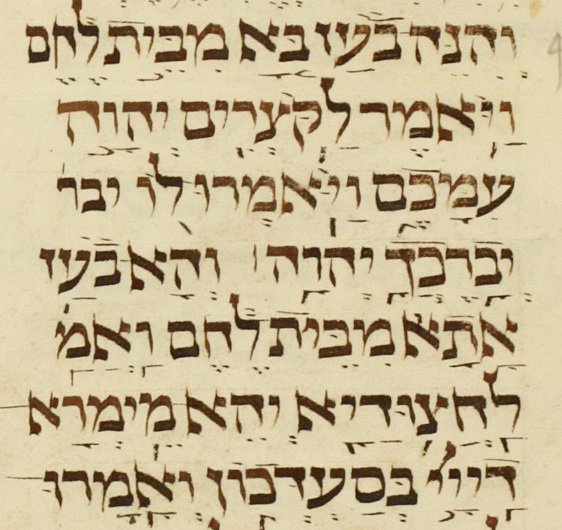
I know, I know. This is an old and hackneyed debate and there are far better/worse modern translations to go after. But as I am finishing up my translation of Targum Ruth (huzzah!) I see that the NRSV has made some lame choices, presumably to be “gender inclusive.” In this case there is some basic biology and not just patriarchal dominance behind the language:

Ruth 4:13
‏וַיִּקַּח בֹּעַז אֶת־רוּת וַתְּהִי־לוֹ לְאִשָּׁה וַיָּבֹא אֵלֶיה
So Boaz took Ruth and she became his wife. When they came together…

Really? Yes, it was consensual and I firmly read the Book of Ruth as having strong female roles, but they don’t need the help of the translator.


Translation – Resistance is futile

I make no bones about it, I am no linguist. I do not derive great joy (and usually, no joy at all) from hours spent trying to decipher and understand grammar. Don’t get me wrong, I love it when I have developed language skills and believe it is vital to read any text to be studied in its original language. (And I am really not that bad.) But I don’t get the great and deep satisfaction out of the linguistic aspect of the whole enterprise. My interests are exegetical, which require keen knowledge of the language, but not grammatical and linguistic. Thus to translating any text, in my current case, Targum Ruth, is vital to a project of understanding an ancient exegete’s interpretations. So I was late last night pounding my head against TgRuth 3:12 (thank you James Tucker for diving into it with me via twitter!)

This morning I awoke to find my good friend John Hobbins, who is an excellent linguist, writing about Translation. My translation of TgRuth should be done later today. Look for it here!

Turning now to the languages of the Bible: the bulk of the Bible is written in a vernacular: ancient Hebrew. Never mind that standard biblical Hebrew in particular was also, quite probably, a lingua franca relative to spoken dialects of Hebrew, regional or otherwise, in the late First through Second Temple periods, in the land of Israel and (as time went on, very importantly) in the diasporas of the Assyrian, Babylonian, Persian, and Hellenistic periods. The point here: at the same time, and of utmost importance relative to the cultural confrontation of which ethnoi then and now are vehicles, standard biblical Hebrew was a vernacular.

Not just the content expressed in “classical” Hebrew, but the written language per se, form part of an anti-colonial project, in opposition to the culture and propaganda of which (the neo-Assyrian version of) “standard Babylonian” was the vehicle – assuming that (some of) the scribes who gave us the Bible were literate in that language and the “course” or curriculum to which it gave expression (the thesis of people like David Wright and Bernard M. Levinson); in opposition to (content expressed in) the more pervasive (and perhaps less insidious, though one should never forget Jeremiah 10:11, to be read in strict conjunction with Ps 82) the more widely used (and still often unknown, or poorly known) lingua franca of the Assyrian empire, Aramaic. These facts form part of the background of a comment like that found in Isaiah 36:11 and the style-switching that Gary Rendsburg has noted.1 On “the invention of Hebrew,” on Hebrew as a vernacular and vehicle for culture expressive of oppositional political theory (a theology), see the volume by Seth Sanders of that title, introduced here.

Still don’t understand why the difference between a lingua franca and a vernacular is a big deal? Try this article on for size, by Tim Parks (HT Charles Halton for the link). The title alone is worth the price of admission: “Your English is Showing.”

via Why biblical literature resists translation – Ancient Hebrew Poetry.


Word Clouds Illuminating Interpretation: Lamentations

Yesterday, as simply a means of illustrating the announcement about the new book on Lamentations I quickly created two word clouds of the Book of Lamentations and the Targum of Lamentations. As with Ruth there are some interesting observations one can make from this simple graphic. For those not familiar, Wordle.net  tags the words you input and produces a “cloud” of words.

The clouds give greater prominence to words that appear more frequently in the source text.

A few limitations for biblical studies is obvious: (1) I am using English translations. In this case NRSV and my own of TgLam. (Wordle will do Hebrew, however, so I should try that too. (2) This is just an approximation. The size of a word is based upon its frequency, but the images are evocative and point to real data.

All of this is reminiscent of my very first paper and article (“Targum Lamentations 1:1-4: A Theological Prologue,”) in which I did a very simple word count to see how many words the targumist had added to the opening four verses of Lamentations relative to the other verses in TgLam. The results were indicative that something was going on there. The article (and later, my book) get at just what that is.

So let’s look at the word clouds and make a few observations.

“The LORD” stands out in both (all) word clouds and with good reason. The term occurs throughout the text. While Lamentations descries the horrible atrocities of the siege and destruction of Jerusalem, the poet refuses to not engage God. The cry, lament, and accusation all are directed to the LORD. That does not change in the targum, in fact it gets even more insistent.

Now, notice that “daughter” (בת) is prominent in the biblical text. In the targum we find “congregation” (כנשתא). This is because the targumist has consistently (but not exclusively) translated the Hebrew בת with כנשתא. The effect, as I have written elsewhere is to remove the poetic “daughter Jerusalem” with the more prosaic yet profoundly person “congregation of Israel.”1 What was an oblique reference to the citizens of the once great city is now an address to those seated in the synagogue, in the congregation, hearing these texts read on Tisha b’Av. Instead of a tedious recitation about something that happened long ago and far away, it is now about you and me, about us and our relationship with God.

Of course these observations came after quite a lot of actual reading of the texts. But it is interesting to see, quite literally, it present in the texts before us. (Be sure to click through to see the English word clouds as well.)

Lamentations - Accordance Module

Targum Lamentations - Accordance Module

(more…)

 
  1. As with all biblical poetry, Lamentations is rendered as prose. This is something I termed “prosaic expansion,” but was first observed in publication by Moshe Bernstein with regards to TgPss. []

Proofs are here! New Book on Lamentations

A year ago, almost to the day, I shared with you all that a new book was forthcoming on the topic of Lamentations and its interpretation in Christianity and Judaism. Yesterday I received the proofs and Great Is Thy Faithfulness: Reading Lamentations as Sacred Scripture should be ready for purchase at SBL! The publisher is now Pickwick Publications/Wipf and Stock. The book is edited by Robin Parry and Heath Thomas. The table of contents follows below.

You know I like wordle.net so here is the Book of Lamentations and below is Targum Lamentations.

Great Is Thy Faithfulness: Reading Lamentations as Sacred Scripture

Introduction—Robin A. Parry and Heath A. Thomas / xi

1 “Holy Scripture” and Hermeneutics: Lamentations in Critical and Theological Reflection—Heath A. Thomas / 1

2 Outrageous Demonstrations of Grace: The Theology of Lamentations —Paul R. House / 26

Soundings in Jewish Reception History

A Lamentations in Isaiah 40–55—Lena-Sofia Tiemeyer / 55

B The Character and Significance of LXX Lamentations —Kevin J. Youngblood / 64

C Targum Lamentations—Christian M. M. Brady / 70

D Lamentations Rabbati—Jacob Neusner / 77

E Introduction to Rashi’s Commentary on Lamentations —Mayer I. Gruber / 83

F Lamentations in Jewish Liturgy—Elsie R. Stern / 88

G Lamentations in Modern Jewish Thought—Zachary Braiterman / 92

Soundings in Messianic Jewish Reception History

H Holocaust Theology in the Light of Yeshua? Messianic Jewish

Reception of Eikah—Richard Harvey / 101

Soundings in Christian Reception History

I Lamentations in the Patristic Period—Heath A. Thomas / 113

J Christian Interpretation of Lamentations in the Middle Ages —David S. Hogg / 120

K John Calvin’s Interpretation of Lamentations—Pete Wilcox / 125

L Lamentations for the Lord: Great and Holy Friday in the Greek Orthodox Church—Eugenia Scarvelis Constantinou / 131

M Lamentations and Christian Worship —Andrew Cameron-Mowat SJ / 139

Soundings in Artistic and Contemporary Reception

N Musical Responses to Lamentations—F. Jane Schopf / 147

O Lamentations in Rembrandt van Rijn: “Jeremiah Lamenting the Destruction of Jerusalem”—Heath A. Thomas / 154

P Psychological Approaches to Lamentations—Paul M. Joyce / 161 Q Feminist Interpretation(s) of Lamentations—Heath A. Thomas / 166

3 Wrestling with Lamentations in Christian Worship—Robin A. Parry / 175

4 Confession and Complaint: Christian Pastoral Reflections on Lamentations—Ian Stackhouse / 198

Appendix 1: A Translation of LXX Lamentations—Kevin J. Youngblood / 211

Appendix 2: A Translation of Targum Lamentations —Christian M. M. Brady / 228

Appendix 3: Lamentations Rabbati on Lamentations 3:1–21 —Jacob Neusner / 248

Appendix 4: Rashi on Lamentations 3:1–21 / 264

Appendix 5: Calvin on Lamentations 3:1–23 / 267