January 14, 2014
Charles Miller, in the comments, shared this quote from Emil Brunner’s The Eternal Hope (available in its entirety as a PDF here). I am not familiar with his work (a lacking in my education, clearly) but have ordered this volume and look forward to reading it. Brunner says what I was trying to articulate in a much more elegant manner:
It can be solved the moment we become clear that there is a before and after to the earthly world. Here on earth there is a before and an after and intervals of time which embrace centuries or even millenniums. But on the other side, in the world of the resurrection, in eternity, there are no such divisions of time, of this time which is perishable. The date of death differs for each man, for the day of death belongs to this world. Our day of resurrection is the same for all and yet is not separated from the day of death by intervals of centuries– for these time-intervals are here, not there in the presence of God, where a thousand years are as a day.
June 25, 2013
I first posted this over five years ago. Obviously these matters have been on my mind for years and even more so of late. I still think this is a plausible understanding and it brings me comfort.
First posted: February 9, 2008
Or what about both? N. T. Wright has made the news again, this time in an interview with Time, and he presents a view of heaven and the resurrection that is not the “traditional” view. Time magazine gave it the lovely title, “Christians Wrong About Heaven, Says Bishop.”
Wright’s view is not nearly as provocative as Time would have us believe. It is also not that new. Of course Wright is correct that most Christians do have a very different view of what happens after death and before the final resurrection than that held by early Judaism and the New Testament. But I am not sure that I buy Wright’s argument of soul sleep either.
Soul sleep is the notion that after death Christians go into a sort of stasis, until the final resurrection and the day of judgment. Wright doesn’t use this term, but it is the one that I first heard my father use when I was in high school and we were discussing these matters. Wright described it this way in the article,
TIME: Is there anything more in the Bible about the period between death and the resurrection of the dead?
Wright: We know that we will be with God and with Christ, resting and being refreshed. Paul writes that it will be conscious, but compared with being bodily alive, it will be like being asleep. The Wisdom of Solomon, a Jewish text from about the same time as Jesus, says “the souls of the righteous are in the hand of God,” and that seems like a poetic way to put the Christian understanding, as well.
Wright’s view certainly does fit the New Testament evidence better than other readings, but I want to suggest a slightly different view.
WARNING: this is all just a theory, feel free to rip it apart, and I do not suggest that it is doctrine in any way. That being said, I do not see that it is heretical or out of keeping with New Testament teachings or conceptions of early Judaism.
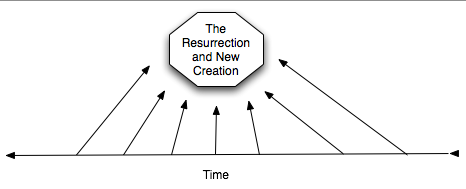
If we assume that God is outside of the space/time continuum then why must we continue to think of the life after death is in a linear progress? Could it not be that when one dies one is also outside of this linear path and thus, regardless of one’s point in history, all arrive at the same moment? Christ’s return then is not “delayed” but is always in the future and always at this moment. Perhaps a graphic can illustrate this better than my words.
Removing the limitations of the linear passage of time opens up other possibilities. It also makes the passage of time less daunting when considering Christ’s return. (Has it troubled any other Christians out there that Jesus was closer in history to David than to us? Brings to mind Douglas Adams’s Hitchhiker trilogy and the Restaurant at the End of the Universe.) Still, I don’t think this conception is heretical and in fact accommodates NT teachings as well.
So what do you think?








62 thoughts on ““Soul Sleep” or Immediate Resurrection?”
My grand theory is here
Thanks Bob! Very interesting and it will take me some time to digest your thoughts. 🙂
With dimension, one has to have positive and negative measures. Such measures are of course relative to a point of origin. So easy for the three dimensional reality we are conscious of.
Occasionally we even name them
– height-depth,
length-? what is negative length?
width-?
time-?, time is bad enough with the square root of -1 in the equations, negative time is maybe redemption, though of course we do measure if vaguely BCE and CE,
glory – ? what is negative glory,
faith-sin (that one was easy),
hope-despair,
love-hate?
Stafford Beer, the father of operations research defined God as a store of negative entropy (= information, In the beginning was the word…).
Our naming game extends our spacetime – but this is for fun, to convince us we do not ‘know’ everything – but what is important is not our knowing – which puffs up, but our love – and our being loved and being known – considering these as divine passives.
Blessings – and thanks for all the fish.
Is this similar to Emil Brunner, C.S. Lewis and Narnia and Dr. Frank Stagg of the Baptists in America? Dr. Stagg wrote a book called New Testament Theology in which he used the concept of time and eternity and instantaneous resurrection. Do I see 2 Corinthians 5:1-10 in your thinking?
Deacon Charles E. Miller, BA, MA
Charles, I am afraid I do not know Dr. Stagg’s work, but certainly that passage from 2 Cor. informs my overall understanding of the resurrection but I don’t see in it any clear sense in chronology (other than the linear nature which binds a narrative structure such as writing).
As for CS Lewis I certainly have read much of his work and I recall his Great Divorce keenly, but I have been unable to find a copy of it again. If I recall correctly, he too has a very linear notion, with the bus coming and going to pick people up, some arrive at one time others at another. I cannot recall any passages in the Narnia books that might touch upon this, can you refer me to them?
C.S. Lewis in Narnia seems to me to reflect two time frames, the one of Narnia and the one of earth. Time spent on Narnia is not the same as time spent on earth. The children in the story may spend 10 years on Narnia; however, on earth only a few minutes have passed after they left. They return to earth and only ten minutes have passed since they left. They also arrive in Narnia in a non-linear fashion. Centuries have passed since the last time they were there. Also, the train wreck scene has them going to Beyond the Shadowlands (Heaven). They seem to be in a bodily state. They arrive in the eternal state immediately after death. That is the way it seems to me. I could be wrong. I recommend Dr. Stagg’s book to you. Its title is New Testament Theology by Dr. Frank Stagg. It can be ordered on the internet. It deals with instantaneous resurrection and relates also to Dr. Emil Brunner from the Eternal Hope. I like your graphic. It is interesting. I hope we correspond again. It is good to speak with someone about these things. I also do it with my wife, Nancy.
Charles
Charles – I have not read the train wreck seen in decades, so I will have to review that, but the chronology of Narnia still runs in a linear fashion, albeit faster than our time here on earth. And, if I recall The Great Divorce it reflects a similar conviction to that which you summarize in the train wreck episode in Narnia; They immediately arrive in heaven. This is where my suggestion differs from Lewis’ depiction in that I suggest that everyone arrives at the same time immediately following death, regardless of their point in the earthly chronology.
Thank you again for the suggestion of Stagg. I will try and get around to it!
Dear Chris,
I want to thank you for your discussions with me. They were quite interesting. It meant something to me since my father went to heaven in 1985 and my father passed December 18, 2006. I was a bank officer with Bank of America and my wife was a professor at Old Dominion University in Norfolk, Virginia. I read what appears to be your profile. You are a dean at Penn State. Perhaps I will add one of your books to my extensive library one day. My BA is in German language and literature and my MA in Religion. I would say that I am a moderate Baptist and former United Methodist. In any case, I appreciate your time.
Charles
Charles,
It was my pleasure and I am glad that this notion brings some solace. As I have said before, I wouldn’t argue it as doctrine, but at the same time I do not think it is heretical. But in suggesting this over the years many people have told me that it has brought them comfort. I think that has some very real value.
I’ve actually thought about that after reading N.T. Wright’s
articles on the subject and I’m glad that I’m not the only
one to think that this might be the case. We might very well
time travel to the future where Christ returns and we are raised
from the dead in a new body. We may never even be alone. Our
loved ones may already be there with us. I’ve often thought,
okay, my loved ones in Heaven are waiting for me, but it may be
the case that I’m already there with them in the future.
It makes my brain hurt thinking about it but God invented time
so he can break the rules if He wants to because He is God.
Duane
Duane,
I also think we will travel into the future to meet the returning Jesus.
A very helpful book on this topic is Arthur Custance’s, Journey Out of Time
Michael
NT Wright on Soul Sleep
Here is what NT Wright supports, I obtained this quote from another site:
Wright definitely does not advocate soul sleep. He thinks that the intermediate state is some sort of restful, conscious existence in the presence of the Lord (hence the use of ‘paradise’ as a description which wouldn’t make much sense in terms of soul sleep), until the day of resurrection when we will be re-embodied.
To quote from Surprised by Hope: “all the Christian dead are in substantially the same state, that of restful happiness. Though this is sometimes described as ‘sleep’, we shouldn’t take this to mean that it is a state of unconsciousness. Had Paul thought that, I very much doubt that he would have described life immediately after death as ‘being with Christ, which is far better’. Rather, ‘sleep’ here means that the body is ‘asleep’ in the sense of ‘dead’, while the real person – however we want to describe him or her – continues.
… it is a state in which the dead are held firmly within the conscious love of God and the conscious presence of Jesus Christ, while they await that day. There is no reason why this state should not be called ‘heaven’, though we must note once more how interesting it is that the New Testament routinely doesn’t call it that, and uses the word ‘heaven’ in other ways.” pp.183-184
Explicitly, Wright states that “the Christian dead are conscious” (p. 185). This is from the section in the book on ‘Paradise’, pp. 183-187
Paradise? Jesus said to the thief on the cross, ” I tell you today, you WILL BE with me in paradise.”
The same paradise Adam and Eve were in with the tree of life. Referred to as such in Genesis. Its not that difficult. There were no comas in the original Greek text. Preconceived doctrines were put onto the translation to English. This is not necessarily inspired. Jesus was only the Messiah if He was dead for three days THEN rose. Would you think He comforted the thief by saying you will be dead with me today? No, He was answering the thief question, which was, “Lord, remember me WHEN you come into your kingdom.” This is at the Second Coming, our Blessed Hope, on the last day. And if you are wondering why Jesus wouldn’t have said Let me tell you, you will be with me in paradise when I come again. (Or someone hinges like that) why w o uld He add the word “today”? My opinion was that He was emphasizing g the fact that even though He looked like a beaten, defeated man at that moment, He does have a kingdom come. And its not of this world, yet. GOD BLESS
Jamie, you argue for biblical consistency and that “soul sleep” is “a 100% biblical doctrine” yet this is an excellent example of a passage which contradicts such a view. Or at the very least requires incredible exegetical gymnastics to make it fit your model. So a few quick points:
• Paradise – Is not a term used in Genesis so it cannot refer to the Garden of Gen. 2-3. By the first century it does, however, come to mean the future idyllic place in 2 Esdras it is the place of the dead. In various other ancient contexts it is equivalent with “heaven” and presumably should be understand in that way here.
• If they were to be together “in paradise” on THAT day then it could not also be the Second Coming, “on the last day.” “If words have any meaning and God is not the author of confusion” then Jesus meant that when they died that day they would be together in Paradise.
• I /suppose/ you could argue that “paradise” is a kind of landing place, a purgatory or stopover, for the righteous where they then “sleep” until the last day. But then the thief presumably wouldn’t know that he was with Jesus there because he would be “asleep.”
Finally, if everyone were to be “asleep” waiting to arise only at the very end, then what of those in Rev. 7:14? They are already before the throne of God, actively worshiping and praising God.
And that would bring me to a general comment in regards to your other note below. Language is never “simple,” even when it is clear. Language words don’t have “any meaning” they can and often do have many meanings. And there are many genres of literature, just within the Bible itself. The psalmist describing God protecting Israel under his “wings” does not (or so most agree) mean that God has wings. It is understood as metaphor for God’s protecting love. The book of Revelation itself is an apocalyptic text, by its very nature non-literal, full of metaphors and allegories. Which is to say, while I just invoked Rev. 7:14 I wouldn’t lean to hard on it.
I agree with you, Dr. Chris. The dead in Christ are alive this very moment on the new earth (Heaven). As we know, time and eternity are not the same. Your example from Revelation 7:14 is still good. Also, Jesus said that God is the God of the living and not the dead, for to him all are alive. Abraham, Isaac, and Jacob as well as all our lived ones are still living. They are beyond our dimension and sight and time. Soul sleep is NOT logical. God bless. Charles
Brandon, thanks for the additional quotes. At this point the debate is largely semantic as evidenced by the fact that Wright himself, in the Time quote says, “compared with being bodily alive, it will be like being asleep.” Stasis, sleep, restful happiness, no matter how one describes it the person is in some sort of pre-Heaven existence.
The subject is “immediate resurrection”, “Resurrection” means a body once dead becoming alive again. What “alive” means is hard to define. “Immediate” is a sequential term. It suggests time but both the Bible and Einstein see variations of that concept. Semantically it means “without ‘im-‘ anything between ‘medius’ ‘in the middle.” Such is described in I Corinthians 15:52 as, “In a moment, in the twinkling of an eye….”
So what we are talking about is, “The timeless moment between when a soul dies and is resurrected – is made alive in a new BODY.” If it exists without a body, it has not been resurrected. In fact, according to Gen. 2:7 and the definition of the word “soul” (Hebrew “nephesh”) given there, it is not even a “soul” if it has no body. In Gen. 1:20 the waters swarmed with nephesh, fish and birds. And in Gen. 1:24, the earth brought forth nephesh – animals of all kinds. So a soul is an identifiable, formed body that has life, either the life it began with or the after life. There is “no medius”, no time in the middle, and no existing without a body.
There was a sect of Judaism of which we are told 4 or 5 times that they “say there IS no resurrection,” always in the present tense. Whether they thought there might be one in a distant future was not the question. It is the present tense that they denied. Jesus corrects them in Matt. 22:31, “That there IS resurrection . . . (“That the dead ARE RISING . . .” Mark 12:26; “That the dead ARE BEING raised . . .” Luke 20:37, all Greek present tenses denoting on going action in present time) the words “I AM the God of Abraham . . . ” said to Moses at the Bush prove. Why? Because God is not the God of the dead. If Abraham had not yet been resurrected when God was talking to Moses, then God would have been God of the dead, and He might have said, “I was . . ” or “I WILL BE . . .” the God of Abraham. Luke makes is specific, “All are living with God.” Not just some kind of existence but, according to Matthew, resurrected.
When Jesus heard the conversation between the two rich men about Lazarus, Luke 16:19ff, Abraham and the two others already had bodies while the brothers were still on earth. They were in their final state, no crossing over for a final judgment.
“How are the dead being raised? (Greek present tense) “With what kind of body are they coming?” They are COMING WITH bodies, bodies from heaven, not the ones that were planted. I Cor. 15:35ff. not flesh and blood. They are coming with Jesus, but they are going to be raised “first”, before they come. I Thess. 4:17. We are never “naked” without either our earthly tent or our house from heaven, (which we already “have”, present tense) II Cor. 5.
The Father is raising the dead (on-going Greek present tense again). The Son is seeing the Father doing that and so He does what He sees His Father doing. John 5. Paul, in court, says the same thing, Acts 26:8, God is raising the dead.
There is resurrection going on and there is no time between dying and rising from the dead. Resurrection is immediate.
I am a member of a Cooperative Baptist Church in Chesapeake, Virginia. It seems that your view follows that of Dr. Frank Stagg, Cooperative Baptist Theologian, and Dr. Emil Brunner, a Swiss theologian. This is also called Instantaneous Resurrection. My father went to heaven April 11,1985 and my mother followed him December 18,2006. During my father’s funeral, I asked the minister to use II Corinthians 5:1-10. I hope you do no mind answering this question. To what branch of Christianity do you belong? It seems that you are clergy. In any case, God bless you and your ministry.
Charles E. Miller, BA, MAR, Abschlussurkunde in Biblische Studien
Dear J M Moes,
Are you familiar with Frank Stagg, BA,ThM, PhD? He was a Southern Baptist Professor who served at Southern Baptist Theological Seminary. He believed in resurrection at death.
Charles E. Miller, BA, MAR, DipBS, Abschlussurkunde in Biblische Studien
I agree with your interpretation about the resurrection. I believe that when Jesus returns, he will be revealed with the blessed dead who are already raised. I see that in Colossians 3:1-4. In any case, I wish to thank you for your contribution.
Dear Mr. Moes,
I must agree with what you say. Since time and eternity are not the same, I must believe in immediate resurrection, a view held by the late Rev. Dr. Frank Stagg of Southern Baptist Theological Seminary. When my father went to heaven in 1985, I used 2 Corinthians 5:1-10. The pastor of Jackson Memorial Baptist Church said the following: It is my belief that today, Charles Miller aged 56 years, has a new body. My mother went to heaven December 18.2006. I miss her terribly.
“Did God REALLY say you shall SURELY die?”, hissed the serpent.
Dear J. M. Moes,
I can understand what you are saying. Both of my parents are with the Lord. My father went April 11, 1985 and my mother followed him December 18,2006. I used 2 Corinthians 5:1-10 at my father’s funeral. I am a Cooperative Baptist and belong to Churchland Baptist Church. Would you mind saying what you background is? You sound as if you have a minister’s background. In any case, you sound as if you have sound reasoning. God bless your ministry.
Charles E. Miller,Jr. BA, MAR. Abschlussurkunde in Biblische Studien
I do not believe that the view you mention is heretical. I do like the Apocryphal Book of the Wisdom of Solomon. That teaches the immortality of the soul. I now believe that we live as a soul in the intermediate state until the resurrection at the Last Day. Of course, the Wisdom of Solomon is influenced by Greek Philosophy; however, I accept its teaching.
I’ve thought this same thing. I am wondering, though, if the book of Revelation might debunk this view. The saints seem to be aware of what is happening on earth. See, e.g., Rev 6:9-10.
Thanks Brian. I agree that Revelation does depict things in this manner, but I am not sure that this is to be understood in a very literal way. Again, if God, and those who die in faith, are outside of time-space then omniscience is simply an awareness of all that has happen(ed)(ing).
Matthew 22:31-32 NASB
But regarding the resurrection of the dead, have you not read what was spoken to you by God: ‘I am the God of Abraham , and the God of Isaac , and the God of Jacob ‘? He is not the God of the dead but of the living.”
Michael, an excellent citation, but it does not really answer much other than to confirm the resurrection. It doesn’t tell us the detailed mechanisms of it. Again, if all, once dead in this world, are outside of our linear space-time continuum then they are already raised.
And…now that I think a bit more about it, Matt. 22:31-32 could even support my suggestion. That is to say, a traditional understanding places the resurrection at some future point. If that were the case then Abraham, Isaac, and Jacob are NOT YET raised from the dead, but here Jesus seems to be asserting that they are ALREADY alive again.
As an aside, of course Jesus’ citation of Scripture is itself a great bit of word play and what we would later come to refer to as rabbinic type of exegesis (cf., Paul in Gal. 3:16). The fact that the text is in the present tense “I am the God of…” rather than the past tense becomes the exegetical basis for Jesus’ point. Of course a modern exegete might object to such an interpretation, saying that the present tense of those sentences do not refer to the status of the patriarchs.
Dr. Brady,
How do you work this in with final eschatology? Is it premillennial, postmillennial, or amillennial? It seems that the view of immediate resurrection could only fit amillennialism. I am now a postmillennialist. B.H. Carroll of Southwestern Baptist Theological Seminary also accepted this view.
I suppose technically my views would be defined as “amillennial.” I think most of Revelation, including chapter 20, should be understood as poetical. What do I consider the specifics to be? I can’t really offer you an answer to that. I think there is so much detail and yet broad brushstrokes that it is impossible to identify 1:1 correspondence for most of Revelation. In this passage I think we find allusions to everything from the Babylonian exile (with multiple exiles and restorations ≈ millennium and resurrections) to the Pax Roman, from the martyrs of the Maccabean revolt (2 Macc. 7) to those of the Christian era, so picking any specific timeline from this would be difficult (and foolhardy, “no one will know the day or hour”).
That being said, I do not see how my pet theory cannot still fit into this. My challenge to our usual approach is to just this sort of linear thinking. We cannot help but to think of time as an endless string or, a string with a beginning and an end, but one that goes on indefinitely from our perspective. God and we once we have passed this life would be outside of this linear time frame. To return to Rev. 20:11, recognizing its poetic nature, I suggest that this moment before the “great white throne” is ever and an ongoing, from one perspective, or never and not yet in another. Here on earth things continue in our plodding linear march. Birth and death, evil and grace and still no sign of Jesus coming again. Yet when we close our eyes in this world we all, at the same “time,” open them before the white throne. No soul sleep, no waiting for loved ones, but all at once. The second coming is now and yet it is not yet.
These texts about the God of the living Abraham, Isaac……can be confusing but I think if we understand what God was trying to say at that time through the prophet we can properly apply the texts purpose. I believe alot of pagan ideas were saying that everyone is subject to the.passage through the underworld or subject to a/the god of the dead. I believe God was making a contrast between Himself and the god of this world whom is the originator of death.(and false doctrines) Death, in other words, was not to be the hope of existence or a means to ascension.
It seems that many read into the text. Its not implying anything. If you believe the same God inspired the whole bible we can expect consistancy. When in doubt look at the whole bible. When Lazarus was dead what did Mary say to Jesus? I know I will see my brother again at the resurrection. She didnt say when I die. When is the resurrection? On the LAST DAY. If words have any meaning and God is not the author of confusion. Soul sleep is bible consistant fact. People just cant leave their preconceived notions at the door and let the bible speak its truth. Not meaning to be harsh to you or anyone. I am just passionate about this. When I realized the bible was clear on “soul sleep”. And so many Christians cry heresy at my belief. People should at bare minimum recognize this as a 100% biblical doctrine.
Dr. Brady,
I will say that I like your response to my last comment. You are influencing my thought patterns again. I must say you are a great thinker. I can imagine that your thoughts are very interesting and I enjoy reading them. I can see your point. I like it! May God bless you in your work. Perhaps you and I have already met in eternity. If you ever establish a blog concerning creation, please let me know. I have read Francis Collins’ book and liked it. I am a member of BioLogos and have read several of their books. I hope you have a Happy Easter.
Dear Dr. Brady,
I hope you have a Merry Christmas. Would the view of an immediate resurrection also be known as the Perspectival View? The dead are outside of time. Dr. J. P. Moreland writes about this in his book “Beyond Death.”
I have another thought that might interest you. Colossians 3:1-4 might perhaps support your view as well. When eternity breaks into time one day, Christ and the blessed are revealed and not resurrected since they have already risen.
I had thought of this concept, certain passages do seem to suggest it.
But then for every passage I have found supporting this view I have also found passages that seem to conflict with it and hint at a period of ‘limbo’ or nothingness if you will where the person is truly dead and awaiting the resurrection. Though being truly dead and waiting, one would not be aware of time passing and so it would seem an instant even if a Million years had passed.
If we enter another state of consciousness outside of time upon death then theoretically we could observe ourselves still living in the World and therefore be existing in two planes at once.
Just add arrows looking back down at the timeline to see what I mean.
It doesn’t make sense to me if I am supposed to be a single soul/spirit. If I am a spirit watching myself live from outside of time then I must have had no spirit while living or it was divided. This is why I don’t buy the instant resurrection.
I don’t think it is made clear enough. Honestly I find majority of the Bible very vague and metaphorical at best. I will simply see what happens… Or not.
I’ve always thought the same….that when we die, linear time ceases and we essentially jump to the second coming and final judgement. However, it was later pointed out to me that the martyred saints in revelation were watching time unfold linearly, and asking God how long it would be before he avenged his martyrs. That made me pause about my (and your) theory on this.
Thank you Eddie. I do not find these passages contradictory for a couple of reasons. The first would be that these passages are clearly figurative, in my view, and are not required to be taken strictly literally. (I recognize that my whole conception requires the non-literalistic reading of these passages, a position that is well founded in an understanding of apocalyptic literature.) The second, taking the *sense* of the passages seriously, reason is that I think we will be aware of all history once we are no longer trapped within its linear trajectory. A (very little) bit like being on the sideline of a soccer match or football game, you can see a lot of the play, but if you get up to the top of the stands and look down you can see the whole pitch, how the plays develop, and even perhaps the ultimate outcome.
I do enjoy the thoughts of all these good Christian people. I wish all of you a Merry Christmas and May God in Christ bless all of you.
Thank you and blessings to you all as well! Praying for a peaceful and blessed New Year.
Hw do you feel about Emil Brunner concerning his view of instantaneous resurrection? Do you consider yourself as a conservative neo-orthodox? Charles
Charles I am afraid I do not Brunner’s views on this. Can you offer citation so I may research it?
Regarding your second question, I do not think I would use such labels. I am orthodox with a little “o,” holding to the biblical testimony and the creeds.
This is a quote from the Eternal Hope written by Emil Brunner: It can be solved the moment we become clear that there is a before and after to the earthly world. Here on earth there is a before and an after and intervals of time which embrace centuries or even millenniums. But on the other side, in the world of the resurrection, in eternity, there are no such divisions of time, of this time which is perishable. The date of death differs for each man, for the day of death belongs to this world. Our day of resurrection is the same for all and yet is not separated from the day of death by intervals of centuries– for these time-intervals are here, not there in the presence of God, where a thousand years are as a day.
That is a very concise and well-worded description of my view. So I would say that I do agree with Brunner.
I tell you David has not yett ascended into heaven……he is still in his grave. Paul said this?
Are you perhaps thinking of Acts 2:34?
This is in reference to David’s source of inspiration not his current state.
You are correct, Christian. Soul-sleep is not biblical. Time and eternity are not the same. The followers of Jesus are in heaven.
Charles
I have often pondered the notion myself that when we die we enter into God’s realm where time itself is no longer linear. Where a day is no longer a rotation of the earth or a year a revolution around the sun. Therefore I suspect that at the moment of death everything has transpired here on earth’s time and in that instant I am reunited not just with loved ones who died in time past but also after me.
Thank you Dr Brady for this article and discussion. It’s very helpful for me. I have a question:
Was Jesus body resurrected on the same day he died or on the third day? My answer would be the third day. If this is correct, where would Jesus be and what state would his person be in, with his human body still in the grave? In other words, did Jesus have two resurrections…. one in the Eternity and one back in real time?
Than you Kevin, that is a great question and I had not really thought about it from that perspective. After all, what does Scripture tell us? It only tells us when the tomb was empty and when the risen Jesus revealed himself to Mary and the others. A few things occur to me.
The first is that Jesus is exceptional, so I am not sure we can extrapolate from his experience to our own. That being said, there is no reason I can think of that he could not have immediately “awoken” within the presence of God (and all the departed: past, present, and future) on that moment in Good Friday, outside of our linear time. The appearance on the first day of the week would then simply be his reentering into our time stream, as you put it nicely “back into real time.” This would not be a second resurrection, but rather a particular manifestation. All of which might also make us wonder about the fact that Jesus appears and disappears before the disciples multiple times. How should we categorize or label that? Not “re-resurrection” so I see no real complication on this point simply a reorienting of the order of events as they appear to us.
Second, Scripture is not clear on what Jesus’ was up to during those three days. He told the man crucified next to him “this day you will be with me in paradise.” Tradition and the Apostle’s Creed also tells us that he “descended to the dead” (the Scriptural basis is 1 Peter 3:18-20) “He was put to death in the flesh, but made alive in the spirit, 19 in which also he went and made a proclamation to the spirits in prison, 20 who in former times did not obey, when God waited patiently in the days of Noah, during the building of the ark, in which a few, that is, eight persons, were saved through water.” Where was he meeting the thief in “paradise” or in “prison”? This is a very vexing problem with traditional theories of resurrection, but would be made much simpler with the suggestion I have made here. (And of course see Brunner.) He is, as Peter puts it, “made alive in the spirit” upon the death of his body and so is present in both places. True, he had not yet “ascended to heaven,” but again I think that is something particular and unique to Jesus and was a visible moment for the benefit of the disciples (like his prayers in John) rather than a necessity.
Third, in our discussions of the bodily resurrection I think we often forget 1 Cor. 15:42-44, which is relevant to your question about the “state of his body.”
Or again a bit later,
We must remember as well that we experience in a limited, linear fashion and so I do not think any of this is easy for us to grasp or communicate. Scripture uses a variety of similes, images, and metaphors to convey these truths. I certainly do not expect to be able to address every good critique of this particular perspective on the resurrection question. Yet as I have said and written many times, I find this greatly helpful to me, it answers many questions that I have had regarding the timing of the parousia, and offers comfort when I think of those who have gone before us.
Kevin, thank you again for making me think more about this and in a new way!
Thx for reply!
So if I understand you correctly, when Jesus died, he was resurrected immediately to eternity final day with all the saints, leaving his old flesh and blood body in the grave. Then he came back in time on the first day of the week to his grave.
If this is correct, what did he do with his old body. Was it not important that the tomb was empty by his old body being resurrected into his celestial body?
Also a side question: Are you saying that Jesus’ human body can be in two different places at the same time?
Kevin, keeping in mind what I said about Jesus is not like us (or we are not like him), I am not sure what happen with his “old flesh and blood body in the grave.” The difficulty is raised by Paul in 1 Cor. 15, cited above. This “perishable” and physical body is to be replaced with an “imperishable” and “spiritual body.” For most of us, the remains will have decayed. But what of Jesus’ body? There was no time for decay. The resurrected body clearly had the marks of his crucifixion and he was (eventually) recognized by his followers, but it was clearly no longer the same “kind” of body he had before his death.
As for the side question, sure why not? I hadn’t meant to say that but once we are outside of the bonds of this physical world (in a “spiritual body”) then I have no idea what the rules would be.
I’ve pondered this before, and it seems to me that if in God (the I Am), all is the present, and time is not relevant, then the moment of death immediately ushers in resurrection for that person (except in the minds of the living, who are bound by, and keep track of time). Much like the graphic you show.
This (immediate resurrection) is something that I also gradually endorsed as definitely most consistent with, not only the Scripture, but also with apostolic fathers (comparing to “intermediate state of soul” or “soul sleep”).
For example, st Ignatius of Antioch (Letter to Romans 6.1).
One of more prominent advocates of immediate resurrection teaching is also a German theologian Gisbert Greshake. I haven’t read his works, but I found some of its reflection. Namely, Joseph Ratzinger (ex Pope Benedict) debate Greshake’s views
https://www.researchgate.net/publication/331490598_Joseph_Ratzinger's_Debates_with_Gisbert_Greshake_An_Arugment_for_the_Resurrection_of_Matter